
The Past is a Grotesque Animal
It never was what it was.
Note: this was originally posted to my Substack on May 9, 2023. I deleted that Substack a couple years ago and I’m posting these pieces here so they don’t get lost. This post is a sequel of sorts to two previous posts, Raise Hight the Roots (from Dec. 2021) and Gallery of the Body (from Aug. 2022).
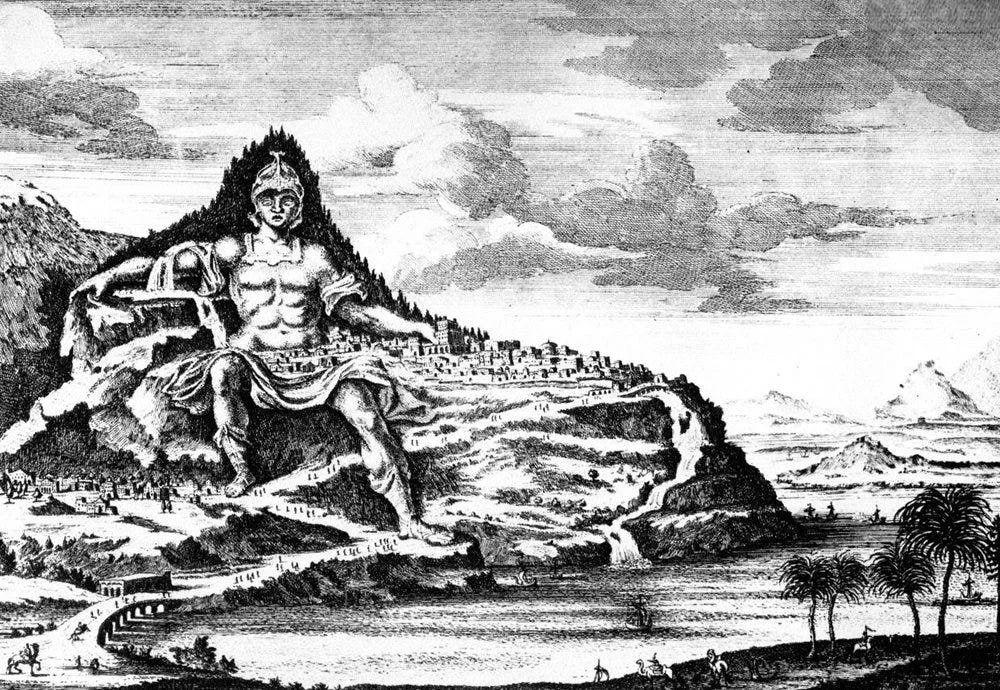
Johann Bernhard Fischer von Erlach, Mount Athos as a Colossal Statue (1721). Vitruvius describes how the Macedonian sculptor Dinocrates proposed to Alexander that he would “form Mount Athos into the statue of a man [Alexander] holding a spacious city in his left hand, and in his right a huge cup, into which shall be collected all the streams of the mountain, which shall then be poured into the sea."
I need a steam shovel mama to
Keep away the dead
I need a dump truck mama to
Unload my head
—Bob Dylan, “From a Buick 6”
Collectors and Collectees
At the archives where I work, we’ve always called the people whose papers we collect “collectees.” I used that made-up term for many years and thought nothing of it until I used it in front of an actual “collectee” and she let out an acrid chuckle. “Is that what we are?” She said this while we strolled past an aisle of glass cases exhibiting various archival documents, including items from her collection. “I suppose it does make you sound like specimens,” I said, tilting my tone slightly towards apology. Nevertheless there they were, the rare specimens, objects plucked from personal remains for being historic; if not, then representative of a career; if not, then visually stimulating or at least strange and fascinating; pinned to the boards and exposed under glass, the exotic beetles of a person’s life. The grotesquerie of the display wasn’t my intention nor my fault — our “personal papers” archives are, by their nature, snugly sleeved inside a casing of aging and death. Impossible to peruse them for long without hearing the awful sound of mortal dread stirring behind its padlocked psychic door. My culpability here is limited, so needs be my apology.
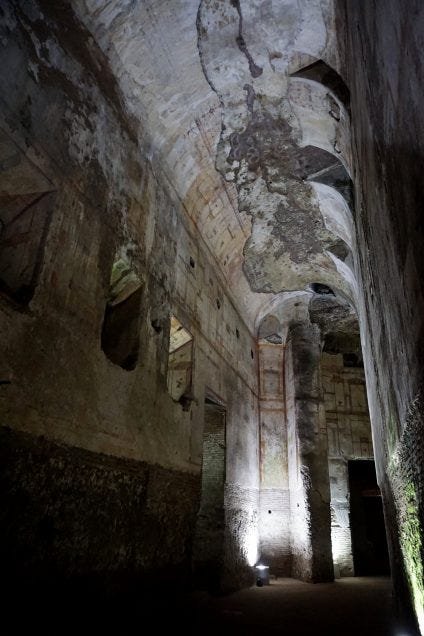
Cryptoporticus of the Domus Aurea, Rome (c. 64-8). Photo courtesy Sebastià Giralt, 2017, CC-SA 2.0.
Ruins of the Golden House
The word grotesque was created to describe a particular, wonderful encounter with the past, specifically by early modern Europeans living among the remains of the ancient Roman Empire. The story goes that one fine day around 1480 a young man strolling on the Esquiline Hill in Rome slipped through a fissure in the earth. He found himself in a mysterious underground grotto — though that word wouldn’t exist in Italian until the 1610s; the Romans would have called it a crypta (taken, of course, from the Greeks, who used the word krypte to mean “hidden place”); our young man might have called it a cropta. This cropta was like nothing else in 1480s Rome: an enormous gallery filled with carved, painted figures, its cavernous walls varnished with endless vibrant frescoes. The young man had accidentally re-discovered the legendary Domus Aurea (“Golden House”) of Emperor Nero.
In July 64 CE, a fire started somewhere among the merchant stalls hawking their wares near the Circus Maximus in Rome. After nine burning days the Great Fire of Rome had destroyed two-thirds of the city. Nero, in the midst of organizing relief, saw an opportunity in the suddenly-cleared land. While the burned-over areas were being rebuilt and improved from their old designs, Nero commissioned work on a massive personal palace-complex. It included its own aqueduct, feeding a monumental nymphaeum fountain-temple whose waters drained into an artificial lake, which was in turn surrounded by a kind of artificial countryside of villas, vineyards, and forests; an entire banquet hall that rotated in sync with the heavens (this might have been a legend until the hall and its mechanism were unearthed in 2009); the Colossus Neronis, an almost-100-foot-tall bronze statue of the Emperor himself; a sunken garden, various pavilions, an art gallery, over 300 rooms (but no bedrooms as it was an event space, not lodgings), endless hallways covered with frescoes, gems, and gold leaf. According to Suetonius (who really can’t be trusted, but is so entertaining he gets quoted anyway) “when the edifice was finished … and he dedicated it, he deigned to say nothing more in the way of approval than that he had at last begun to live like a human being.” Nevertheless, it was only four years into its construction when Nero killed himself in 68 CE at the age of 30.
The Domus Aurea was perhaps the most obvious, enduring public symbol of Nero’s legacy of wanton excess. The jewels, ivory, gold, and other valuable materials were methodically stripped out. Large portions were simply filled with dirt and paved over. I Vespasian built a great amphitheater over the artificial lake (after the Colossus Neronis was moved there it became known as the '“Colosseum”), Domitian commissioned a giant complex of baths (later the Baths of Trajan) built over the Esquiline Wing, Hadrian had the titanic Temple of Venus and Roma erected on top of much of what was left. Within forty years of Nero’s death the Domus Aurea was either destroyed or invisible. By 1480 it was all ruins sealed beneath other ruins.
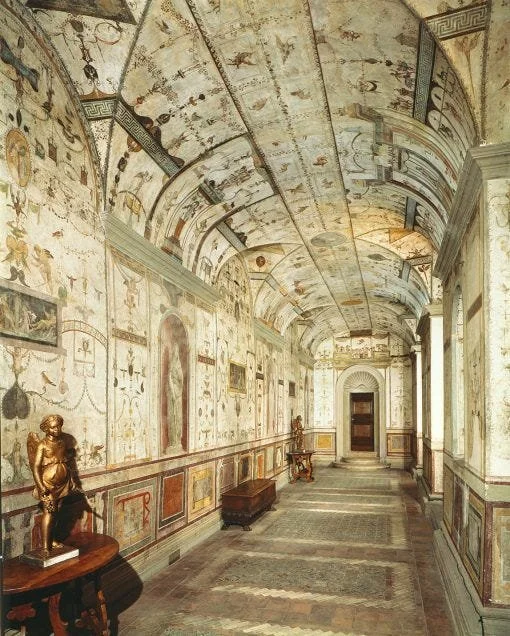
Raffaello Sanzio da Urbino, called Raphael, (1483–1520, Italy) and Giovanni da Udine (1487–1564, Italy). Loggetta of Cardinal Bibbiena, Palazzi Pontifici, Vatican (c. 1516). Fresco. Photo courtesy Scala, Florence/Art Resource, NY.
House of Golden Ruins
The new humanists of Renaissance Rome thrilled to the accidental rediscovery of Nero’s Domus Aurea. The only way to describe this uncanny combination of classical beauty debauched by ludicrous excess and abyssal time was “grotto-esque” — i.e. like the art discovered in the hidden grottoes — in Italian, grottesco, later in French grotesque.
Tyler Rockey writes about the encounter between the Romans of 68 and 1480 in his 2021 piece Between Spaces: The Domus Aurea, the Vatican Loggetta, and Foucault’s Heterotopia:
An anonymous fifteenth-century artist who visited this place poetically described this experience of difference and the oddities of being there: “[I]n every season the rooms are full of painters. Here summer seems cooler than winter . . . we crawl along the ground on our stomachs, armed with bread, ham, fruits and wine, looking more bizarre than the grotesques” (Michael Squire, “Fantasies so Varied and Bizarre: The Domus Aurea, The Renaissance, and the ‘Grotesque,’” in A Companion to the Neronian Age, ed. Martin T. Dinter and Emma Buckley (Chichester, UK: Wiley-Blackwell, 2013), 448).
This type of decoration was the antithesis of what the Renaissance had understood as classical and sought to implement through its antique vocabulary. Grotesque decoration, derived from ancient Roman precedents, was employed in fresco or sculpted on walls, ceilings, and architectural frames. It was characterized by hybrids of plant, animal, and human forms; metamorphic and sprawling ornamental candelabra motifs; and illogical and irrational compositions. … In essence, for the Renaissance viewers, the grotesque presented an inversion of the classical aesthetic ideals of naturalism, harmony, proportion, and rationality of form. And yet this antithesis emerged from the Roman earth and directly out of the classical past, greatly shifting attitudes around this decorative mode through the significance of the discovery of the ruin.
Rockey uses the example of the cryptoporticus of the Domus Aurea (the first photo above) and the way it was reproduced by Raphael within the Vatican itself (second photo) to show how the grotesque came to inhabit the Renaissance imagination:
Sixteenth-century artists went beyond the humanist literary imagination, which had conjured a vision of both present and past engendered by the study of ancient materials, and worked instead directly into the physical urban fabric in order to resurrect the body of ancient Rome.
This is what we see in the Loggetta of Cardinal Bibbiena, a space constructed by Raphael and decorated by the grotesque specialist of his workshop, Giovanni da Udine. Raphael and Giovanni had descended into the heterotopic Domus Aurea sometime around 1510, reemerging with the imagined and idealized mental forms of the spaces they encountered, and transformed these concepts into tangible forms in the current time and space of the Vatican. The shape of the Loggetta clearly recalls that of the cryptoporticus and the ethos of the former’s decorations are inspired by the latter’s ceilings and walls in a manner that most closely imitated the original space to date.
…This reimagining of the cryptoporticus and the resurrection of its decorative mode and means of execution in effect suspend the heterotopic, temporal difference at play between the Loggetta and the Domus Aurea. They reintroduce some proximal bundles of relations that tie this space to the larger fabric of the Renaissance. This is what lies in between these spaces: an awareness of the past, the desire for re-completion, and the utility of art in mediating temporalities.
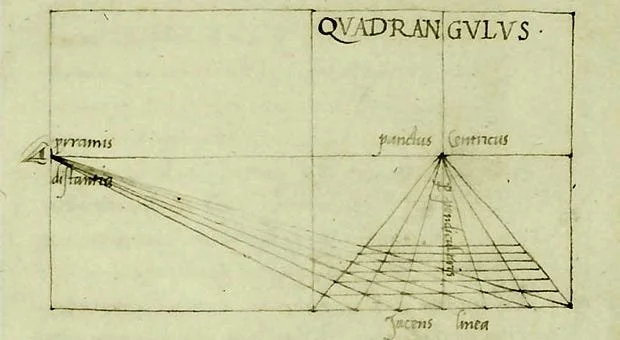
Leon Battista Alberti, from Della Pictura (1435)
In 1435, almost four decades prior to the rediscovery of Nero’s Golden House, Leon Battista Alberti’s treatise Della Pictura used mathematics to show how the human eye creates the illusions of linear perspective, including the horizon and the vanishing point (above). After 1480 the visual representation of perspective — the illusion of depth in space, on a two-dimensional surface — was matched by a conception of visualized “history” as the illusion of depth in time — specifically their location in the foreground of that pseudo-spatial depth. If this foreground is understood as the present, then we also accept that it’s in constant motion, sliding from the clarity of the foreground to the obscurity of the background, losing detail as the clock ticks, finally absorbed into the abyssal singularity of the vanishing point. On the base level of physics this is time’s arrow, Newton’s Second Law.
But culture doesn’t obey the laws of physics.
The Grotesque Animal of the Past
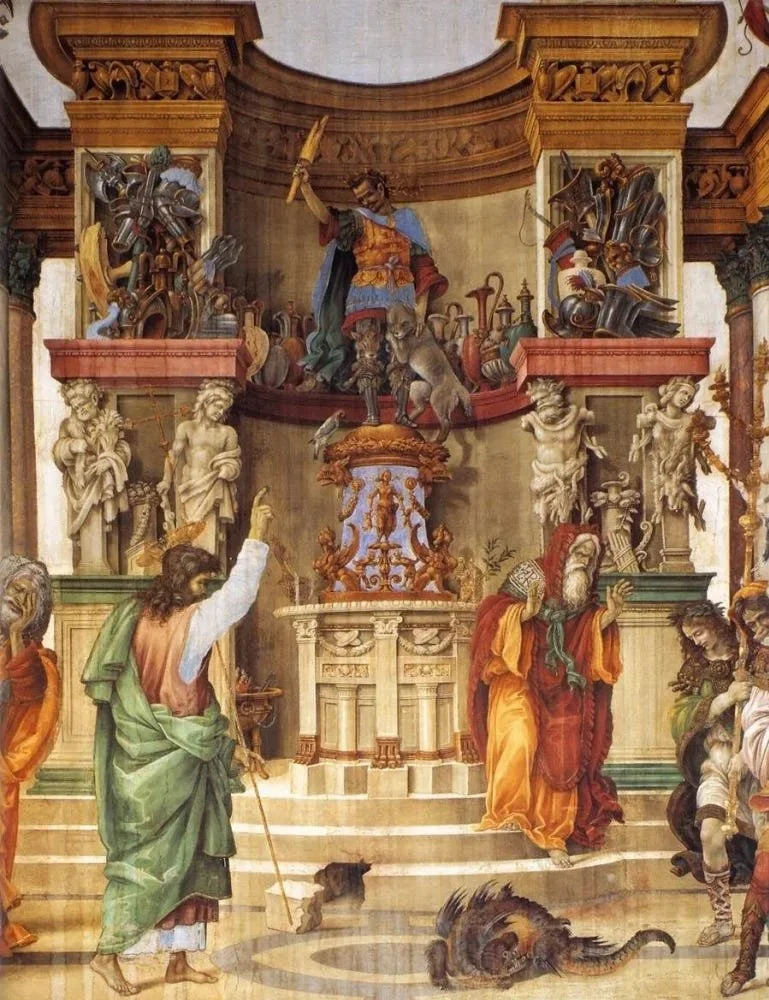
St Philip Driving the Dragon from the Temple of Hieropolis, fresco in Strozzi Chapel by Filippino Lippi, Santa Maria Novella Principal Dominican church in Florence, Italy. Created ca. 1490 CE.
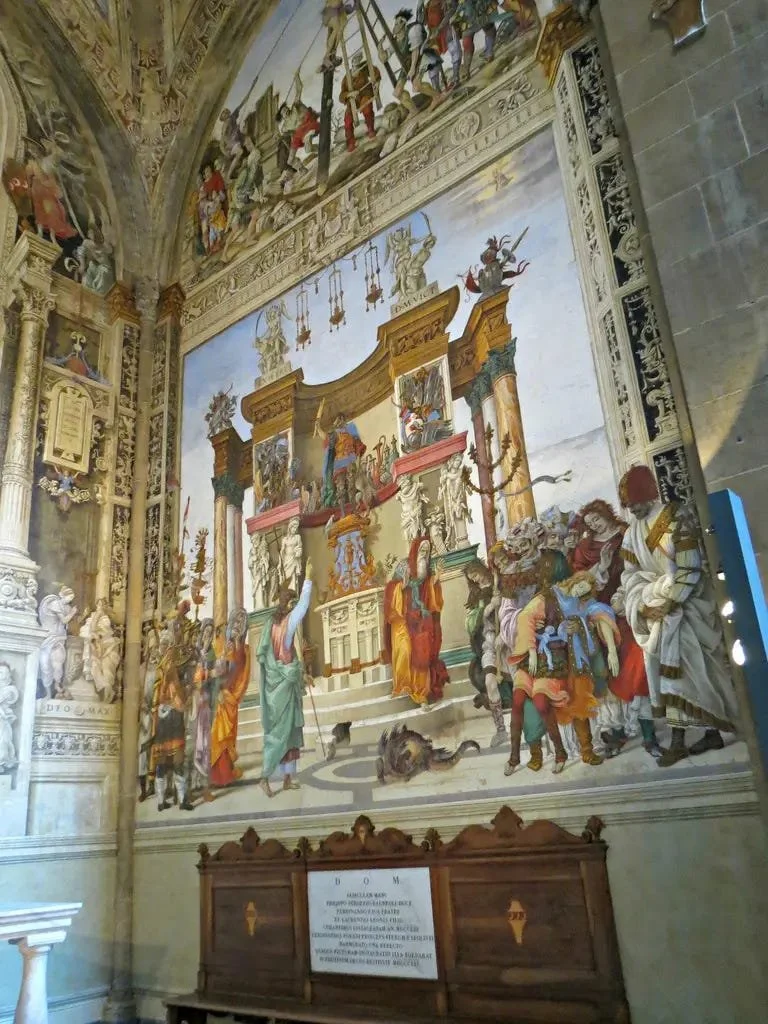
Wider view of the above work, for scale.
Filippino Lippi was one of the artists whose style was transformed by spelunking in the Domus Aurea. The world that exists within his art is suddenly sharper and brighter. Everything feels heightened and amplified; a dialectic rages between a realism of detail and an artifice of impossible colors, poses, and subjects, synthesized by the beholder into Dali-esque surrealism.
One of the first major pieces created by Lippi after his journey into the grotesque past was the fresco above. In the fresco, Philip the Apostle is in the Greco-Phrygian city of Hieropalis (where he will later be martyred, crucified upside down). He is approaching a creature on the ground, which everyone else in the images is cowering away from in terror or literal disgust — the story goes that the breath of the creature was sickening the inhabitants of the city. The image captures the moment when Philip approaches without fear, intent on casting out this malevolent force with the righteous power of Christ, literally cleansing the city and bringing it salvation in the process.
But take a look at the creature in question. What is it? It’s described as a dragon, yet it’s so strange, so stylistically jarring, so obviously grotesque in the modern sense, that “evil monster” doesn’t do it justice. Even if we take it at surface value, why is there there? Was it summoned? How did it find a home there? There are oddities that might be clues, like the piece of broken stone at the foot of the altar, which might be the kind of esoteric symbols Renaissance artists utilized to ultra-densify their work. But I think there are larger, tidal forces represented by this encounter.
The image is totally dominated by the pagan altar, in the center of which is a gold-on-blue pedestal decorated in a style straight out of the Domus Aurea. Lippi’s representation of the literal grotesque is at the visual core of this work, because in this context it represents the past — specifically the shock wave resulting from the impact between the past and the present. The counterpart to Philip in this image isn’t the “dragon” on the floor, it’s the pagan statue on the altar, its arm raised in an invocation of holy power, a gesture echoed by Philip. The statue’s arm holds a broken sword and is surrounded by armor and the trappings of war and violence; Philip, dressed plainly compared to the others, holds no weapons and approaches with humility, his face obscured by his outstretched arm. The dragon faces away from him, perhaps unable to face his purity. The loose stone near the dragon almost suggests that the dragon was birthed from the altar itself, suggesting that the believers in the pagan past have inherited only decay and pestilence masked by splendor. The splendor, however, is still there, and in the context of the artwork it’s impossible to ignore. Perhaps Lippi has mixed feelings about repudiating the pagan past? Perhaps he can reconcile the old and new, synthesize them even, in a newly-discovered-yet-still classical aesthetic — the grotesque.

A grotesque animal.
Lippi’s fresco is an nexus of confrontations: pagan and Christian, Classic and Renaissance humanist, Lippi’s own past as an artist and his new style, all of the above and the eternally present moment of beholding by us. The historical, conceptual foreground is crowded with overlapping vertices, a vertiginous collision of perspectives, out of which chaos is born the creature that crouches and snarls at eye-height to the viewer; the animal that both is grotesque and represents the grotesque, the monster birthed from this churn of past and present, clawing its way towards us from the forbidden zone of time’s vanishing point.
The Past is a Grotesque Animal
In 2007 the band Of Montreal released their album Hissing Fauna, Are You the Destroyer? Dead center on the track listing is the hypnotic, minimalist twelve-minute long song “The Past is a Grotesque Animal.” Over the course of the song Kevin Barnes supposedly transforms into a Ziggy Stardust-like alter ego named Georgie Fruit, who performs the rest of the album (and the next two Of Montreal albums). Why would he do this? According to Rolling Stone:
DURING THE RECORDING of Of Montreal’s eighth album, Hissing Fauna, Are You The Destroyer?, Kevin Barnes was going through a difficult time. "On a creative level, my life was going great," the songwriter told Rolling Stone, "but on a personal level, it was totally falling apart." Epic 12-minute track "The Past is a Grotesque Animal" is the centerpiece and turning point of the album, on which Barnes embodies his alter ego, Georgie Fruit. "I'm not suffering from split personality or anything," he said, of the multiple personae on the record. "This just gives me an opportunity to write from a different perspective [emphasis added]."
The song starts with Barnes singing:
The past is a grotesque animal
And in its eyes you see
How completely wrong you can be
The rest of the song is a series of memories, present thoughts, impulses, second-guesses, regrets, reflections. A chord sequence repeats as a pattern in the constant musical present while, for the singer, the past and present overlap each other. But we now know: wading through the smashed-together wreckage of “before” and “now” is our very experience of the true present. All moments are intersections in time and space, all histories are imaginary histories, all imagination a merging of images and magic.
Kevin Barnes’s semi-singing style in this song is close to something called sprechstimme, literally “speak-singing,” which is close to what you’d hear in a musical, and also an art song, the kind favored by the late, great soprano Phyllis Curtin.
The Soprano’s Handwriting
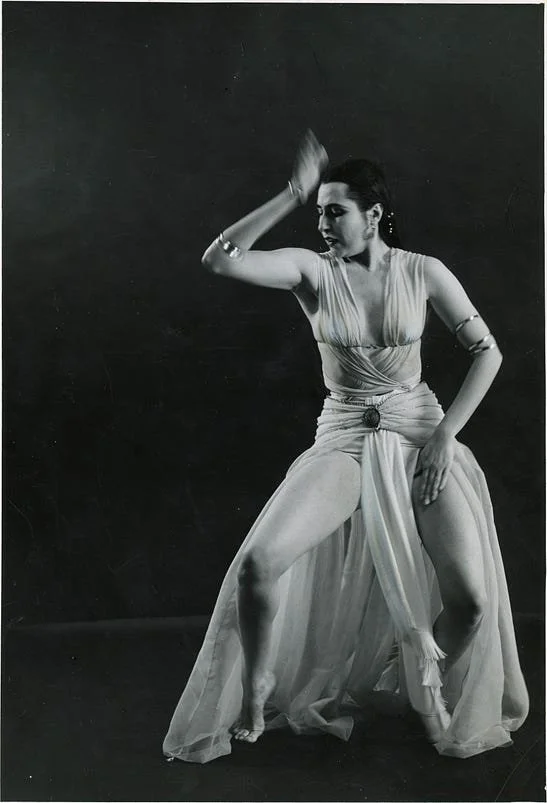
Phyllis Curtin performing as Salome in 1954.
It used to be part of my job to drive out to collectees’ homes in a rented cargo van or mini-van, usually with a partner. We would go into their garage, basement, or attic, gather up whatever it was they wanted us to have, and drive off with it back to the archives. Many collectees were cordial and welcoming and often would insist on feeding us. We were packing up their life’s work and carting it away; they were stirred them into a range of emotions: nostalgia, relief, mourning, curiosity about the the workings of the archive. Others, usually the children or grandchildren of the original collectees, made it clear we were there to clear some storage space and should get off their property as soon as possible.
In March 2004 I had to drive out to Great Barrington, Massachusetts to the home of Phyllis Curtin. Mrs. Curtin was a legendary soprano, a beloved teacher, and one of those people about whom no one can think of anything bad to say, an amazing feat in the backbiting worlds of opera and classical music. My co-driver got sick at the last minute so it was just me and a van and my printed-out MapQuest pages to take me from my apartment in Quincy, Massachusetts six hours across the entire state and six hours back again. My daughter was not quite a year old and had already decided that she despised anything that impeded her constant movement, including and especially sleep. So I was bleary when I set out around 4:00 am for the Berkshires. I exited the Mass Pike and wound my way to a plain black mailbox where I turned onto a dark brown dirt road. I found myself driving through farmland, then a short corridor of trees new with spring green, then finally a large, brown house where the road ended.
The house looked like various smaller dwellings slotted together. Behind the main house were some outbuildings that looked like small barns. In one of those barns Mrs. Curtin had stored the papers of her husband, Eugene Cook. He had been a longtime photographer for Time-Life and was, of course, a collectee. When I eventually got back to the office, a co-worker described how he had been sent out to that same property back in the 1980s to acquire the Eugene Cook collection, and how he had to wrangle hundreds and hundreds of prints, negatives, and slides out of a hayloft. He may have exaggerated a bit but it does explain the scent of straw that still clings to the photo prints.
Inside the house I was greeted warmly by Mrs. Curtin and her large dogs. She led me around the corner into an open area where a black metal music stand was stationed next to a slightly dusty grand piano. Next to this tiny rehearsal space was an alcove of shelves and cabinets; these held the scores and sheet music I had come for.
We went through the loose sheet music together — the bound scripts, she said, were pieces she wasn’t ready to part with. I was looking for pieces that had her own notes on them, as that made them unique, and thus good specimens; she was looking to weed out pieces that she never sang, as she felt they didn’t belong in her papers. She would sometimes point out individual pieces when they sparked a memory, reeling off stories about Leonard Bernstein, Virgil Thompson, and Ned Rorem, all of whom had composed songs for her to sing. She would hold a piece in front of her, sometimes softly sound a note or two, smile, and hand me the score — or it would spark nothing and she would slide it onto to the reject pile.
I was specifically chosen to be there because the people at work knew I had a “background in music,” which to them meant I could read music and recognized composers’ names. Some of them knew that I had spent a year at New England Conservatory right out of high school, where I majored in bassoon performance. What no one knew, because I didn’t tell them, was that my year trying to be a professional musician almost killed me. I wasn’t cut out for a life of nothing but constant practice, rehearsal, and competition. The stress of it, combined with my gnawing fear at finding myself utterly adrift, truly messed me up. At some point I stopped eating much, then bathing, then sleeping. Instead of practicing I would wander the streets of Boston, usually ending up in a bookstore or library until closing time (having lost track of time). I was lucky enough to still be seeing my girlfriend from high school, who was also going to college in Massachusetts and was a train ride away (we married a few years later) so we were able to support each other during that year — she had gone to a Christian college and was coming to realize that the school’s religiosity was not for her. I was also lucky enough to transfer to a different school after that year, where they assumed I would want to join the orchestra. But I never wanted to play music on a stage again, so I never have, and I probably never will.
While I was going through the scores with Mrs. Curtin I noticed some handwriting that looked different from hers on a few pieces, so I asked her who that other person was who had written on these scores. She looked confused, so I handed her an example. She laughed when she saw it. “When I was a girl growing up in West Virginia,” she said, “I wrote with my left hand. But back then you weren’t supposed to be left-handed. The teachers would hit my hand with a ruler if they caught me writing with my left. So I started writing with my right hand in front of the teachers. They thought I switched” — she chuckled — “but really I just trained myself to write equally well with both hands. When they weren’t watching I would still use my left hand. Those notations are both me, sometimes I used to switch back and forth between hands — that’s what you’re seeing.”
We were together in that windowed room, and she was in Clarksburg, West Virginia, and I was staring blankly at the wall of a basement practice room on Huntington Avenue; perhaps she was on a stage somewhere singing a song Ned Rorem wrote for her to sing, perhaps I was in Jordan Hall huffing as hard as I could into a contrabassoon playing along with Mahler’s 4th Symphony, both of us hearing music of the past, vectors of time cross-crossing next to that dusty piano and those pine cabinets. This is our experience of temporality. Not how we live it as packets of matter in the backwash of entropy, jellyfish carried on the cosmic tide of the expanding universe, but how we inhabit it as living beings with minds and memories: tracks and trajectories of our pasts, real and possible, true and imagined, psychological and historical, constantly searchlight-sweeping from background to foreground and back again. Where the lines merge they briefly constellate into shapes, creatures perhaps, animals beautiful, and ugly, in other words: grotesque.
When I had collected all the specimens I could I made to go, eager to get on the road for my six-hour return drive. But Mrs. Curtin insisted that I stay for lunch, which, after a brief and frantic scan of her pantry, ended up being Cambpell’s tomato soup for two. As we ate I told her that someone from the archive would come for the rest of her papers whenever she was ready. She leaned forward and pointed her spoon at me. “I think it should be you,” she said.
“It never was what it was”
The 1976 television series I, Claudius has an early scene set at the birthday party for the Roman Emperor Augustus in 24 BCE. One of the entertainments the Emperor has lined up is a poetic recounting the Battle of Actium by a renowned Greek orator. The quiet the hall, an unnamed usher steps up and slams his staff on the floor three times, shouting “Caesar calls for silence!”
The Greek orator is stunned. “What a voice!” he says. “Perhaps we should change places! Only the Romans can afford ushers with a voice like that. Did you have any training?”
“I was an actor, sir,” the usher replies.
“Oh, that explains it. Resting, are you?”
“No sir, I’ve given it up. Everyone’s an actor in Rome. There just isn’t enough work to go ‘round.”
“And what there is goes to friends and relatives, it’s the same everywhere.”
“The theatre isn’t what it was.”
“No. And I’ll tell you something else. It never was… what it was.”
(The scene is at 8:30 here, if you want to watch it for free.)
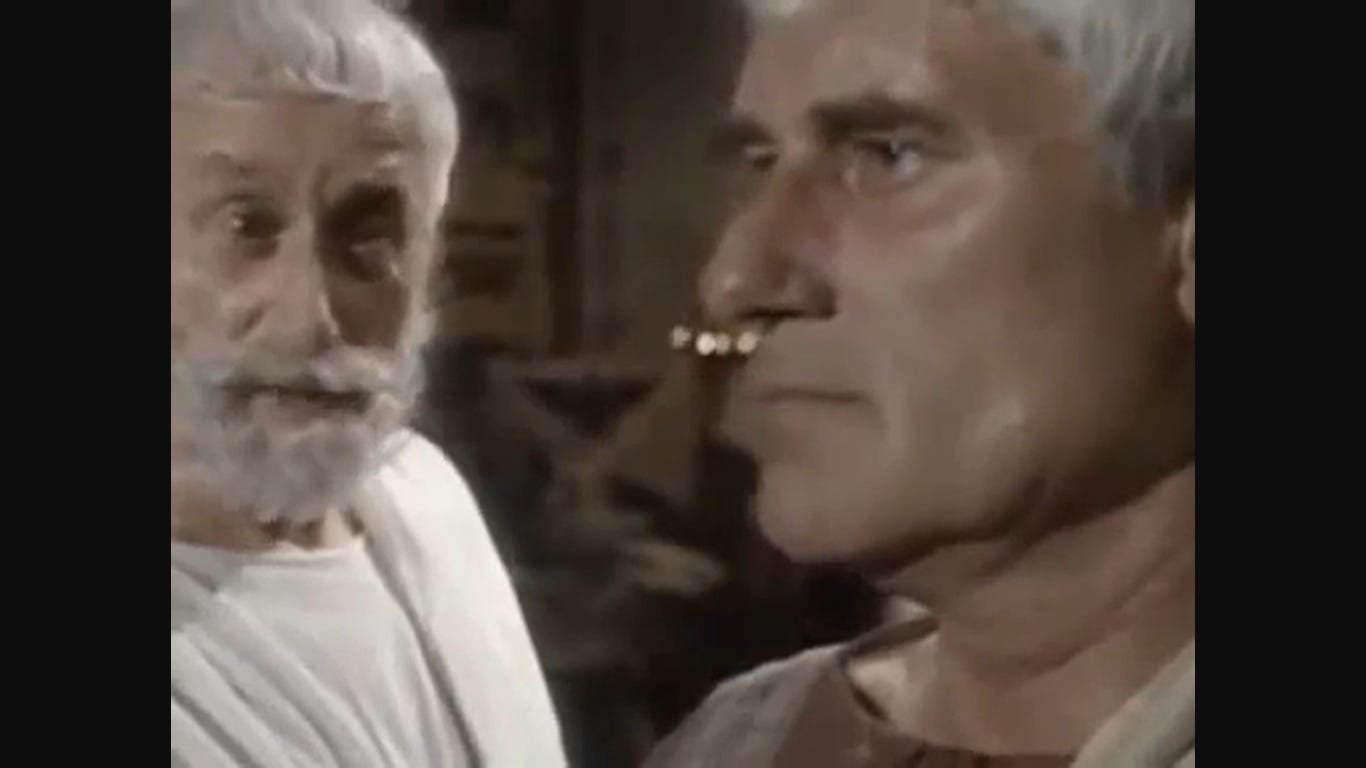
This is one of the first iterations of a motif that runs through the series: never forget you’re watching a story. The series opens with narration by Claudius late in his reign, writing his memoirs and relaying events that happened before he was born, in case it wasn’t clear that what we’re seeing lies somewhere between fact and fiction. These are British actors in the 1970s portraying fictionalized versions of (mostly) real people who lived over a thousand years before, adapted from two books by Robert Graves who picked the juiciest morsels from primary sources that were often relaying secondhand tales, gossip, and propaganda. The low-fi quality of the makeup, sets, props, and film stock has gone from merely adding camp to a serving as a stamp of analog authenticity. I rewatched the whole series in 2020, to keep my mind occupied during the long nights of the first COVID wave, which for me adds yet another layer of associated-memory onto the show’s time-onion. (Later, I listened to the I, Podius podcast, which recaps each episode — a funny concept for a show that aired about 47 years ago — and found myself once again wanting to rewatch it.)
I wonder, now, if the many original British and American viewers of I, Claudius appreciated the story about a powerful, global empire reduced to a state of moral and structural decay through the avarice, pride, and myopia of its rulers — as that was also their contemporary world? Or is that just me, projecting my own illusory vector backwards from my foreground position back towards the horizon, seeing a line where none exists? Was it never what it was?
After the Greek orator is finished, Augustus pulls him aside to thank him. “What a gift you Greeks have! Incidentally, you know — the battle, it wasn’t like that. But you described it poetically, I understand! You used poetic license. I’m used to that!” It never was what it was. All histories are imaginary histories.
Story of the EYE (I)


In September 2022 I spent a full week in a hospital bed in Boston. My head was wired to an EEG machine that was constantly monitored by someone I couldn’t see, though I could see my own brainwaves on a large screen on the other side of my small room. To my left was a large window displaying on a slab of roof and another tower of rooms across from mine. I could only leave my bed if the nurse was present, which meant I was prone almost the entire time. By the time I was discharged I found I had to re-learn how to walk as my legs un-stiffened and my equilibrium recalibrated to keep me standing.
A ride-share driver guided me through the afternoon traffic to my train station. The sky was gray with rain but everything pulsed with color. I could try to describe it, or you could scroll back up and imagine the esplanade along the Charles River glowing like a fresco by Filippino Lippi after he had seen the Domus Aurea. I had turned 48 years old during my hospital stay and here I was learning how to walk and how to see again.
The goal of my visit was to solve the mystery of a series of seizures I suffered over the last three years, the first of which almost killed me. I got no answers, but I did get a clue that perhaps what was happening to me was some combination of the mental and the physical. This led me to wonder if it was related to my autism, which I had been assessed for a few months prior. That in turn led me to read the book Unmasking Autism, by Devon Price. Price lays out how autistic people create “masks", i.e. personae that function to fake their way through everyday life. My persona “Ryan,” for example, is a work of art - almost a work of fiction, except so much of him was crafted by mirroring others and trying to anticipate their expectations. “Ryan” is outgoing, witty, polite, comfortable in groups, self-effacing, socially functioning. But “Ryan” is an appendage of another being, a grotesque animal without a true name but for our sake we’ll call it EYE. EYE puts on the “Ryan” mask as needed; has been doing so since EYE was a child. But after so many years of use it started to crack and peel. Like so many other things, the pandemic sped up its decay like a time-lapse film.
It took me a long time to make it through Unmasking Autism because I would read a passage like this:
Though masking is incredibly taxing and causes us a lot of existential turmoil, it’s rewarded and facilitated by neurotypical people. Masking makes Autistic people easier to “deal” with. It renders us compliant and quiet. It also traps us. Once you’ve proven yourself capable of suffering in silence, neurotypical people tend to expect you’ll be able to do it forever, no matter the cost. Being a well-behaved Autistic person puts us in a real double bind and forces many of us to keep masking for far longer (and far more pervasively) than we want to.
And this:
Therapy that is focused on battling “irrational beliefs,” such as cognitive behavioral therapy (CBT), doesn’t work as well on Autistic people as it does on neurotypicals. … One reason for that is many of the fears and inhibitions of Autistic people are often entirely reasonable, and rooted in a lifetime of painful experiences. We tend to be pretty rational people, and many of us are already inclined to analyze our thoughts and feelings very closely (sometimes excessively so). Autistics don’t need cognitive behavioral training to help us not be ruled by our emotions. In fact, most of us have been browbeaten into ignoring our feelings too much.
… and I would have to pause to take a breath or calm down. I would get deeply angry thinking about all the years I spent trying to inhabit a skin that wasn’t really mine and never could, or should, have been. I was suddenly very defensive of the young EYE who could never feel a sense of peace between the bullying, the dismissal, or the praise that backfired. I realized that I had embraced Zen Buddhism when I was 15 because I thought it would teach me ego death, since killing my sense of self felt like a way to commit virtual suicide, faking my own death to myself so that nothing could touch me. But nothing could touch “me” anyway, since EYE was inside the carapace of “Ryan,” afraid to come out. I can forgive myself, though, which makes forgiveness for anyone else irrelevant.
My anger passed through me and I was left with the resolve to let myself be changed this time. I had to stop trying to swat away those beams of time that kept trying to converge on my location, let them illuminate me and I will see with my EYE open for a change. Some of that is middle age too, of course, the perspective of knowing that there’s more years behind me than in front of me. But like we said, we experience time all together, always in the foreground. Everything (everywhere?) all at once.
Story of the EYE (II)
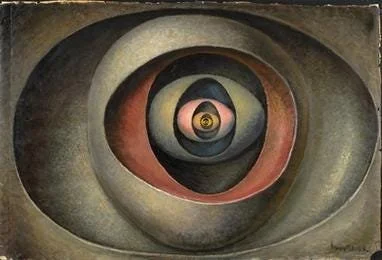
Eye in the Egg [Silm Munas], by Ülo Sooster.
In “The Past is a Grotesque Animal,” Kevin Barnes/Georgie Fruit sings:
I fell in love with the first cute girl that I met
Who could appreciate Georges Bataille
Standing at Swedish festival
Discussing "Story of the Eye"
I discovered an English translation of Bataille’s Story of the Eye (L'histoire de l'œil) when I was 17, purely by chance at the public library in the town where I grew up. (It was this edition; in part I was taken by the cover, which freaked me out.) At first glance it looked like a long, disturbing series of viscerally disgusting sexual fantasies, but there was something in its relentless description of bodily functions that made me wonder if I was falling into a trap by reading it all too literally. I re-read it and sure enough without the shock factor, actual themes emerged from the viscera. It never was what it was, it was something more.
An early motif is the character Simone’s obsession with eggs. This comes back at the end of the book, when she is transfixed by the face of a dead priest (which the main characters have killed) when a fly briefly lands on his open, lifeless eyeball. Then there’s this brief moment (translated from the French by Joachim Neugroschel):
She [Simone] made me come over to the corpse: she knelt down and completely opened the eye that the fly had perched on.
“Do you see the eye [l’oeil]?” she asked me.
“Well?”
“It’s an egg [l'oeuf],” she concluded in all simplicity.
There’s something symbolically wonderful and physically gross about the idea of an eye, or an EYE, being both an organ of observation and generation. Another grotesque combination! Perhaps the EYE has seen enough, has incubated for long enough, perhaps something will yet claw its way free. The past is a grotesque animal, and in its EYE you see how completely wrong you could be. But then again, all histories, including the history of the EYE, are imaginary histories. If it never was what it was, who knows what it will possibly be?
Raise High the Roots
Where I discover I am autistic at the age of 47
Note: this was originally posted to my Substack on Dec 9, 2021. I deleted my Substack a couple years ago and I’m posting these here so they won’t get lost.
When he was 11 years old we bought my son Z (I’ll call him that) a bowler hat. I think we originally got it for his Halloween costume. He loved it and started wearing it all the time. No matter where he went, at home or in public, rain or shine, he kept that bowler hat on his beautiful round head.
I thought it was a charming eccentricity, thinking to myself “he really loves that hat!” feeling pleased about it as you do when your child finds something in this merciless world that makes them contented. But he kept wearing it and I started to feel embarrassed. My wife and I knew that our role in Z’s life as Good Parents was to calibrate our children to the expectations of Society, so strangers aren’t confused or upset by how the children look or speak or act. Society can’t allow for exceptions because where that would lead? Rich people get to be eccentric because everybody around them only cares about their money. We’re not rich so we have to fall in line.
However: Z has a sibling who is four years older. We had learned what might be the most important thing I have ever learned: children don’t learn through discipline, they learn through example. I know how corny this sounds -- and I’m breaking my own rule against never, ever giving parenting advice to anyone, but -- you must do it. If you want your child to be a good person you have to be a good person. It’s so easy to be petty and mean and mocking and that becomes their mental script. Sometimes it’s exhausting to be as kind and generous as possible. Not perfect! If you try to raise perfect children no one will come to your funeral.
That’s enough of the Advice Column. We learned to love Z’s hat because he loved it, and we love Z very much – much, much more than we desire Society’s approval – so it was a simple equation. It gave Z an aura of dignity and poise. It also helped that he was a charming young man who happened to adore puns. And we learned about the history of bowler hats, how they were designed to be sturdy and stylish, a combination hard hat and working class men’s apparel. Our daily existence is more interesting and better-looking because of Z’s hat.
We wanted to understand Z better. We suspected that he might be on the autism spectrum and we wanted to make sure that we could help Z however he needed us to. So when he was 13 years old we brought him to a neuropsychologist for testing. He charmed the testers, of course. He took a few different tests and sure enough landed on the autism spectrum. On the one hand he scored in the top 99.7 percentile for verbal ability, which explained all the puns. The tester told Z that in a theoretical room with 1000 people, only 3 would score higher than him. We were in the actual room with Z when we heard this, so we were definitely humbled. On the other hand the tests confirmed that Z has a hard time processing information in groups, especially with audio. He can also get flustered when he wants to talk and it comes out too fast, so he has to back up and try again. And he has other autistic patterns and habits. One thing we’ve noticed is his meticulous attention to detail, especially in two areas: preparing food and painting wargaming miniatures. I’m always impressed by his patience and jealous of his lunch.
When Z first learned he was autistic he took it in stride with a swoop of his hat. Having it all confirmed by an authority figure meant that other people would take us seriously. And the clarity was liberating. Z learned a great deal about autism and autistic people over the next few months. Before long he was openly proud to be an autistic person.
Very late in 2019 I started to hear about a "Chinese virus outbreak" from, of all things, a podcast that both explains and makes fun of Alex Jones. I mostly forgot about it until early 2020. My workplace shut down in mid-March 2020 and we all started working from home. We mostly had each other for company for weeks, then months. Z could relax and be as autistic as he wanted because Society was paused.
That's when I noticed it.
Z would do something and I would think: well I do that too. He would tap his fingers on things. I tap my fingers all the time, sometimes to tunes that loop in my head. Z would stick closely to regular routines, which I like to do. I realized that I have a kind of politeness that's almost an exaggerated performance, which Z sometimes does. For as long as I can remember, I've had a fast, complex pattern of pen or pencil-flipping that I do with one hand; it used to drive people crazy because it was so distracting. My wife pointed out that Z was doing it while he was working on a math problem. There were other things, small things, but they began to add up.
One summer day I decided to go online and look at some common aspects of autism in adults. I could imagine that one or two could apply to me and I was curious to see what they were. Then I started to tick them off. "Prone to monologue on a particular subject," sadly yes. "Exhibiting strong, special interests," absolutely. "Tendency to engage in repetitive or routine behaviors" -- I have patterns that repeat like programming subroutines that are coded to loop over and over again. "You're the 'absent minded professor' of the family," "you often invent your own words for things," "you prefer individual games and sports," "you stick to regular routines and get upset when they are changed." Yes to all.
I also realized that some of the things I've always done I assumed everyone else did too. I love foreign languages -- I've studied Russian, Italian, French, and Ancient Greek -- to the point that I like listening to songs in languages I don't understand. Apparently that's not normal? I've always had facial tics that would show up for weeks, sometimes months at a time and then disappear. My mother used to call them "nervous habits." Not everybody had those? Not everyone gets self-hypnotized by random, minor details they notice in visual or audial patterns, so that they tune everything out? Gets physically upset by loud noises that everyone else things is fine? Is ridiculously early for everything? Doesn't like eye contact and absolutely can't stand most social interactions with other people? Is totally adverse to conflict? Was it just me?
I had always been told I was shy, or anti-social, or just eccentric. Things that were normal to everyone else, like being with friends or being with crowds, exhausted me. I went through regular bouts of self-loathing and physical lassitude, which led me to think I had bipolar depression. I confessed this to my old boss and she declared I was "moody" and should get over it. After several years, those waves of depression stopped. Now I began to think that all along I had been constantly fighting myself.
As such things go I was the last to realize that I was almost definitely on the autism spectrum, just like Z. I don't have a neuropsych test to go off of, so I can't prove it. But the circumstantial evidence is compelling. Suddenly the previous 40 years of my existence make sense. Z had begun to point out to me directly times when, without realizing it, I was doing things that autistic people commonly did. Once during dinner I confessed that I had a kind of false persona who could be gregarious and friendly in order for me to get through most social interactions. Z slapped his hand on the table. "Dad, that's an autistic thing. It's literally called masking."
Z is fiercely proud to be an autistic person and it outspoken about all the condescending, misguided, harmful attitudes towards autistic people. My own experience tells me that a lot of self-destructive behavior by people with autism might come from living in a world that refuses to let them fully exist. Thriving as a human being, experiencing respect and socially-recognized agency, can be an effective treatment. Experiencing social death is not.
For my part I'm not remotely ashamed but I'm still trying to understand myself. When I was Z's age everything I knew about autism came from the movie Rain Man. The word "neurodiversity" was coined by Judy Singer in 1998, the same year I graduated from college. I only had a real frame of reference after Z was categorized as autistic. Just a week ago, the US Centers for Disease Control reported that, based on their data, 1 out of every forty-four 8-year-olds in the US were categorized as autistic. I have some catching up to do.
I recently asked Z to tell me something which made him proud to be autistic. He told me it was his love of delving deep into subjects that fascinate him -- superorganisms, Warhammer 40K lore, indigenous technologies, all kinds of topics. One of these is the Mycorrhizal network, also known as the "wood wide web." A person walking through a forest is interfacing with an immense organic communication network underneath the soil without knowing it. All along I was strolling through the Amazon colliding with trees, not realizing the real forest knew I was there, was sensing and thinking around me. Halfway through my life I am stopping to put my hands into the soil and find those roots. They've been supporting my weight but I couldn't sense them. I need to reach into the earth, touch them, and listen, and meet them where they grow. If I can commune with them maybe I can stand strong, and rise up, and touch the sky.
The Empire of Haunted Houses
Scary stories and bad dreams in American Suburbia
Note: This was originally posted to my Substack on October 31, 2022. I deleted that Substack a couple years ago and I’m posting these here so they don’t get lost.

…When everything has disappeared in the night, "everything has disappeared" appears. This is the other night. Night is this apparition: "everything has disappeared." It is what we sense when dreams replace sleep, when the dead pass into the deep of the night, when night's deep appears in those who have disappeared. Apparitions, phantoms, and dreams are an allusion to this empty night. It is the night … where the dark does not seem dark enough, or death ever dead enough.
... And this eeriness does not simply come from something invisible, which would reveal itself under cover of dark and at the shadows' summons. Here the invisible is what one cannot cease to see; it is the incessant making itself seen. The "phantom" is meant to hide, to appease the phantom night. Those who think they see ghosts are those who do not want to see the night. They crowd it with the terror of little images, they occupy and distract it by immobilizing it -- stopping the oscillation of eternal starting over. It is empty, it is not; but we dress it up as a kind of being; we enclose it, if possible, in a name, a story and a resemblance…
In the night one can die; we reach oblivion. But this other night is the death no one dies, the forgetfulness which gets forgotten. In the heart of oblivion it is memory without rest. — Maurice Blanchot, The Space of Literature (1955)

Dawn of the Dead
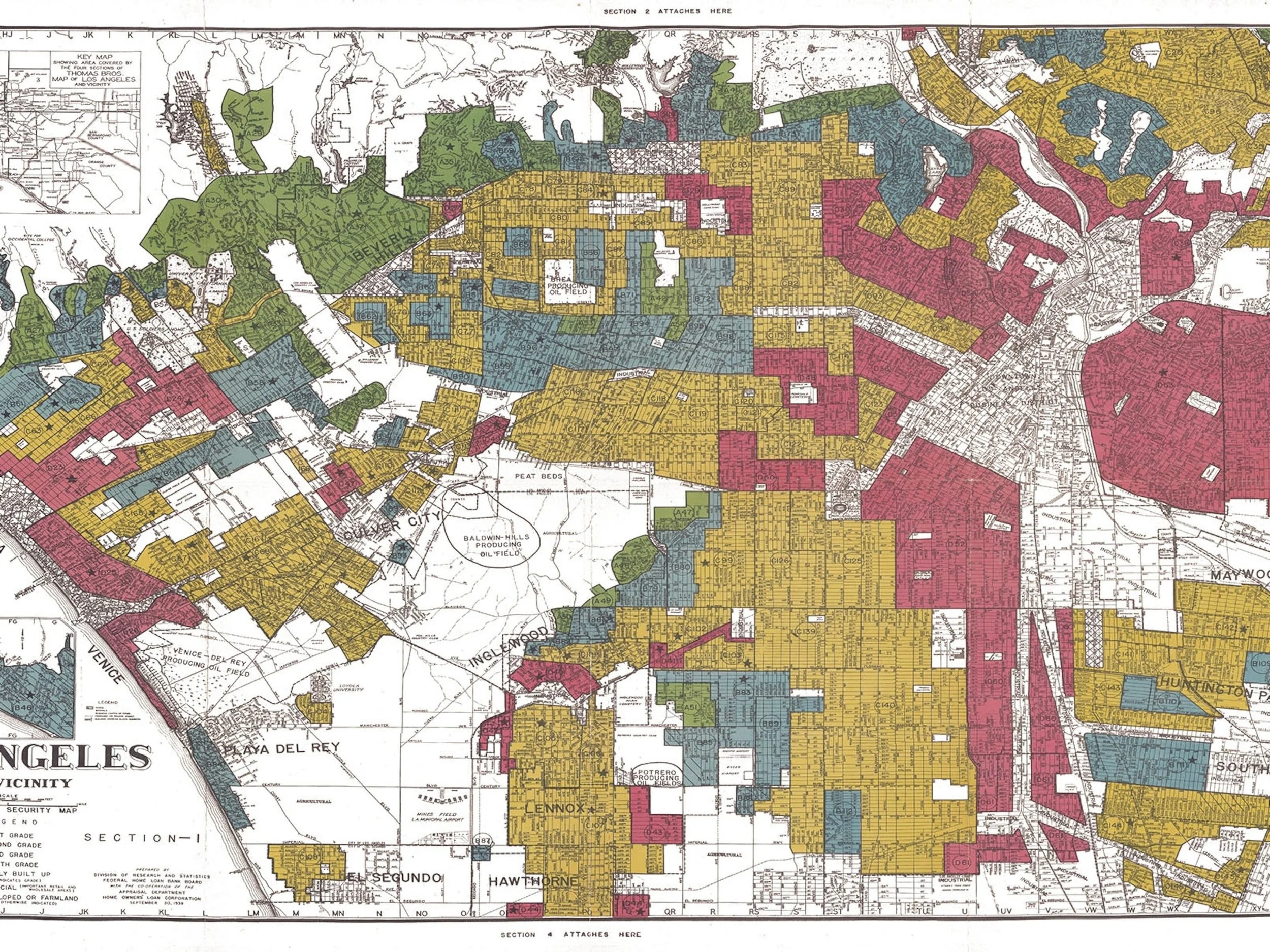
In the early 1930s, the banking sector was trying to stay afloat in the midst of the Great Depression, which meant collecting on as many debts as possible to stay solvent. When the banks tried to recover their outstanding mortgage debt, however, they found the borrowers were often unemployed or their own savings and investments had been wiped out. These mortgage defaults triggered a wave of foreclosures, collapsing the housing market and leaving the banks with numerous empty homes they couldn’t sell (similar to 2007-2008). The government responded by creating the Federal Housing Authority in the National Housing Act of 1934. The FHA was designed to stabilize the housing market by bringing national standards to mortgages and home loans. They also wanted to identify which geographical areas offered safer, better real estate investments; the FHA would underwrite loans in the “safe” areas but not in the “risky” areas, which would in turn further stabilize the market. The trouble was, no one in banking or real estate really knew what counted as “risky” or “safe.”
To answer this question, the the Federal Home Loan Bank Board (a separate agency created in 1932) tasked the Home Owners Loan Corporation with appraising the property values and risk factors in 239 cities in order to create a risk map for each city. The maps would be carved into zones that were ranked and color-coded to identify the relative risk level in each zone. The green zones were Type A, where banks could most expect to get their loans repaid. The blue zones were Type B, labeled “Still Desirable”; the yellow zones were Type C, labeled “Declining.” The worst neighborhoods for loaning money or investing capital were Type D — the red zones.
In theory this color-coded system that reflected some kind of objective financial reality. But the men who did the appraisals for the Home Owners Loan Corporation corrupted the labeling process with their own racial prejudice. The Type A neighborhoods, the green zones, were the new, whites-only suburbs on the urban outskirts, while the Type D red zones were the older, mostly black neighborhoods inside the city limits. This where the red in redlining comes from. There were no strong, or even objective, financial reasons for these appraisals beyond pure racial enmity. But the bankers’ racism was shrouded within the language of risk assessment and investment returns, which kept their consciences as clean as they liked to keep them.
Banks, investors, and municipalities immediately shifted their investment wealth and tax dollars out of the racially-diverse cities into the homogenously white suburbs. Redlining thus enshrined certain neighborhoods as designated enclaves for poor people of color. In the 1930s, for example, the city of Los Angeles had already designated South Los Angeles as a Black and Latinx area; redlining made sure the the real estate was underpriced to attract working-class non-whites and concentrate them in a geographic area. Once there, the residents of South LA found they couldn’t get access to home or commercial loans — as part of the “high risk” zone — which would help keep the residents poor and underserved. Many of the residents of places like South Los Angeles were part of the Second Great Migration. Between 1940 to 1970 more than 5 million Black Americans moved from the South to the North, Midwest and West. They were trying to escape the economic and educational dead-ends of Southern agricultural labor, as well as the brutality of Southern segregation and bigotry, only to find themselves financially and legally corralled into the red zones. Freeways were built around these areas; industrial pollution was allowed to accumulate there; police patrolled these neighborhoods like an occupying army; housing became overcrowded and dilapidated, leading to lower property values; all of which contributed to the underlying poverty, misery, and ill health of the residents. The US had entered the era of what geographer Ruth Wilson Gilmore calls “organized abandonment”:
In the United States, where organized abandonment has happened throughout the country, in urban and rural contexts, for more than 40 years, we see that as people have lost the ability to keep their individual selves, their households, and their communities together with adequate income, clean water, reasonable air, reliable shelter, and transportation and communication infrastructure, as those things have gone away, what’s risen up in the crevices of this cracked foundation of security has been policing and prison.
Now it’s not that surprising when we stop and think that if in an organized way, state and capital abandon people, something is going to arise to shape and direct what those people do who are not absorbed back into the political economy in other ways. It’s really not that surprising, though it is frightening.
So if we look then more specifically at what has happened in state and municipal budgets, we see the expansion of budgets devoted to mass incarceration, to jails, and to police. We see not only that but, in agencies that are supposed to be working toward other ends — education, health, and so forth — a rise in police functions.
One thing that we see happening, for example, is that police in schools has spread across the United States in this period. Or we can look at something as relatively technical and one would imagine benign as a student financial aid, and we see that student financial aid officers in colleges and universities have a policing function as well. Or the fact that the United States Department of Education has a SWAT team. So we see that the policing function has risen not only in the traditional agencies of the police, that is to say, police jail in prison, but also in social welfare agencies. And so it’s that twinned growth that shows us that we’ve been so thoroughly abandoned that we have to take back, we have to take back, which is to change, transform, and move to something new.
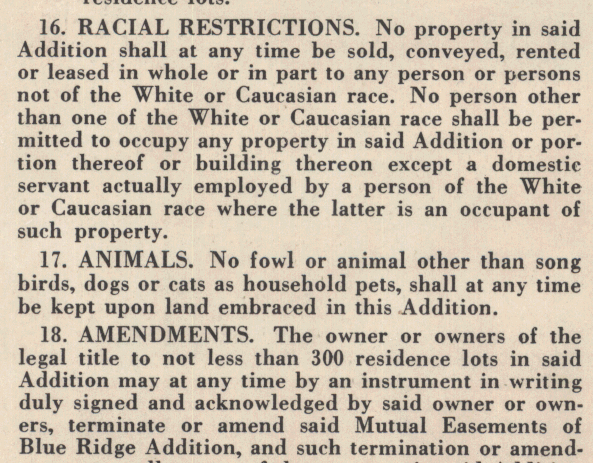
Those who were able to avoid or escape the red zones would find themselves defeated by “housing covenants,” legally valid clauses in housing deeds that restricted the sale of occupation of real estate on the basis of race, ethnicity, religion, and/or social class. Racial covenants came into use in the US during the mid-nineteenth century, but their use exploded in the 1920s and 1930s. They remained routine until 1948, when the US Supreme Court found they were legally unenforceable, though obviously racist property owners routinely found ways to deny leases to Black Americans and other minorities, as demonstrated by Fred and Donald Trump. Usually, the restrictive covenants were specifically racist towards Black Americans, but discrimination against Jews, Catholics, Asian Americans, and European immigrants was also common. It was after World War II that they moved from being a tool of Southern segregation to a way of containing minority home-buyers and renters into designated areas and, just as insidiously, permanently excluding them from vast new developments being built specifically for the other “great migrants”, the white populations steadily fleeing the urban cores.
Blockbusting was a technique used by developers and real estate companies to get white families to move out from urban neighborhoods in cities like Chicago, New York, and Philadelphia, into the developers’ new suburban developments outside those cities. The goal: rattle white property-owners so they would sell their property to developers at low prices so the developers could resell the same property at above-market rates to non-white families, making a large profit. Real estate agents would sometimes hire Black Americans to walk around the mostly white neighborhoods pushing baby carriages or even starting fights. Developers would buy vacant buildings and leave them empty, giving the impression that no one wanted to move in. The white residents would find flyers in their mailboxes advertising cash payments for homes — just in case they were thinking of selling. Non-white families living in urban districts would see the newly available housing and naturally want to buy it themselves. It was the beginning of “white flight,” a fundamental, permanent shift in the demographics, politics, and financial makeup of the United States, and the origin of the modern American suburbs.

Haunted Houses
Housing in the US reached a crisis point in the late 1940s. Houses were both time-consuming to build and expensive to buy, so unless something changed there were always going to be too few houses costing too much money to put a dent in the severe post-war housing shortage. The US government had no intention of building blocks of public housing on its own — that would cost a lot of taxpayer dollars and put Uncle Sam in competition with private home builders — so the government decided to partner with the developers instead. As a result, the solutions to the crisis came in the form of a construction revolution on the developers side, and the creation of the Federal Housing Administration on the government side.
The construction revolution was a new generation of architects and builders, mostly second-generation immigrants, using innovative techniques, standardized parts, and an assembly-line approach that would mass-produce housing without the need for skilled or unionized workers. In 1944, new houses were being built at an average of 144,000 a year; in the 1950s the average was 1.5 million a year. To facilitate the speed of this new construction, the Federal Housing Administration gave low-interest loans to builders and established basic construction guidelines and nationwide standards. The typical postwar house of the late 1940s was the “minimum house,” so named because it met the FHA’s minimum standards. These were smaller than the typical pre-war home, usually 983 square feet, with 5 to 6 rooms — two bedrooms, one bathroom, a living room, and a kitchen, all on one floor. New families found them small but up-to-date, with electrical systems wired for modern lighting and appliances. Their simplicity made it easy for them to be remodeled, so they might be updated and remodeled as needed.
The standards the FHA set for lot sizes, setbacks from roads, building materials, and so on meant these new modern mass-produced houses couldn’t be built in urban areas. New developments would be have to carved out of other spaces, often farmland or existing estates, areas that suddenly didn’t fit the definition of either urban or rural. American banks had to be willing to lend money to the people who wanted to buy these new houses in these new spaces, so the FHA created a mortgage insurance program, which lowered the risk that banks took when lending money to these home buyers. This completely transformed the American housing market for white families. Long term, low-interest loans of 25 to 30 years duration became the norm. These loans allowed many white Americans to own property for the first time, as opposed to renting.
For white Americans who could secure the loans, the fact that buying a home tied up most of their lifetime’s wealth in mortgage debt seemed a small price to pay. As long as the value of their property increased over time, it became the primary way that post-war white families accumulated wealth., Because so many were doing it, a great number of white families felt they were sharing in the post-war prosperity of a newly ascendant United States. Since the real estate could be passed down through families, the wealth was inheritable, which was also a new experience for the majority of Americans.
To reward the servicemen who made that prosperity possible, the FHA worked with the Veterans Administration to give returning WWII veterans — specifically the white veterans — extra aid in their housing purchases. This aid was part of a larger subsidy called the Servicemen’s Readjustment Act of 1944, aka the GI Bill, which also provided financial assistance for higher education costs as well as unemployment insurance. The overall goal of these policies was to create a thriving American middle class that was financially secure and highly educated.
But while the language of the GI Bill as written didn’t explicitly exclude African-American veterans from government benefits, in practice it was enacted in such a way that the economic and educational assistance flowed to whites only. In addition most banks simply would not lend money to African-Americans. Even if a black family could somehow secure a housing loan, they would find that these new communities were closed to them. Some suburban developers, like Levitt and Sons, Incorporated, builders of the famous suburb of Levittown on Long Island, New York, would not sell homes to non-whites (and sometimes excluded non-Protestants). In other areas, if a non-white family did manage to move in, they would find themselves harassed, ignored, or even assaulted by their white neighbors — with the full complicity of the local law enforcement and often the municipal governments — until they finally gave up and left. The developers and the residents justified this treatment by saying that having non-whites live near them would drive down the market value of their own homes and since all their wealth was invested in their homes, they literally couldn’t afford to allow anything that would make their homes’ financial values go down. In this way, they told themselves that, just like redlining, their discrimination had nothing to do with racism. It was just a matter of money.
The US government had already provided suburban whites with lavish handouts in the form of low-interest home loans and educational subsidies when, in 1954, President Dwight Eisenhower announced that the government would be making another such investment by building an interstate highway system. The railroad industry was starting to decline in the face of competition from trucking and air travel, and the new suburban developments were often not near established rail lines anyway. Newer cars were faster, cheaper, and more available, thanks to an expansion of consumer credit. The landscape of America terraformed itself around the automobile; entire industries sprang up to support the new car culture. This in turn accelerated the population shift from the cities to the suburbs. By the end of the 1950s, one-third of all Americans lived in the suburbs, while eleven of the twelve largest cities in the US saw their populations decline — with the once exception being Los Angeles, because it was able to design its infrastructure around the needs of car drivers. Owning a car became an essential element of suburban life; it was practically impossible to live there without one.
The automobile was essentially suburban in another way: it was relatively private. A driver had some sense of privacy, just like the detached single-family homes of the suburbs put a modicum of space between each neighboring family, unlike the density and forced familiarity of the city. The social lives of the new suburbanites tried to make up for this lack of closeness with various civic organizations – social clubs, charitable groups, sports teams, churches, and so on. But mostly the social life of suburbanites outside the home was oriented around children and families. To the 1950s-1960s suburbanites, the city became the world of work and commerce, and the suburbs became the world of leisure and family, with the daily commute connecting the two worlds. Crime, disease, and social problems were part of the urban world; safety, health, and comfort were to be found at home in the suburbs.
The men and women who moved to the suburban promised-lands showed their faith in the future of America by filling their new homes with children. 4 million babies were born every year during the 1950s. It was a new kind of country: not a territory seized by genocide and rebellion; not a nation organically emerging from flows of trade and politics; not a country with fixed borders or cultures or languages; but a floating, shadow nation, its inhabitants often on the move, searching for something “good” — good property values, good jobs, good schools, good parking, good downtowns and good malls with good shopping, good churches, good hospitals, good graveyards, and a police force to keep it all “good.” The “bad” had to be elsewhere. If it looked like someplace was getting “bad,” it was time to move again.
A defining factor of a suburb being “good”: it was cheap, meaning housing was cheap and corporate, property, and individual taxes were either low or nonexistent. Cheapness was important because the successful suburbanite was above all a smart consumer. The point of owning a home was to accumulate wealth, and the point of accumulating wealth was to gain economic and social status, putting one in a position to accumulate more wealth. Legend said that if you worked hard enough for long enough and played by the rules you could attain the mythical status of rich, at which point the wealth would mostly accumulate itself. Until then, no matter how much wealth you had actually accumulated you would consider yourself middle-class, as that meant you were an average person, meaning: normal. The white suburbanites were, for the moment, the self-appointed protagonists of America. Their dreams were the American dream.
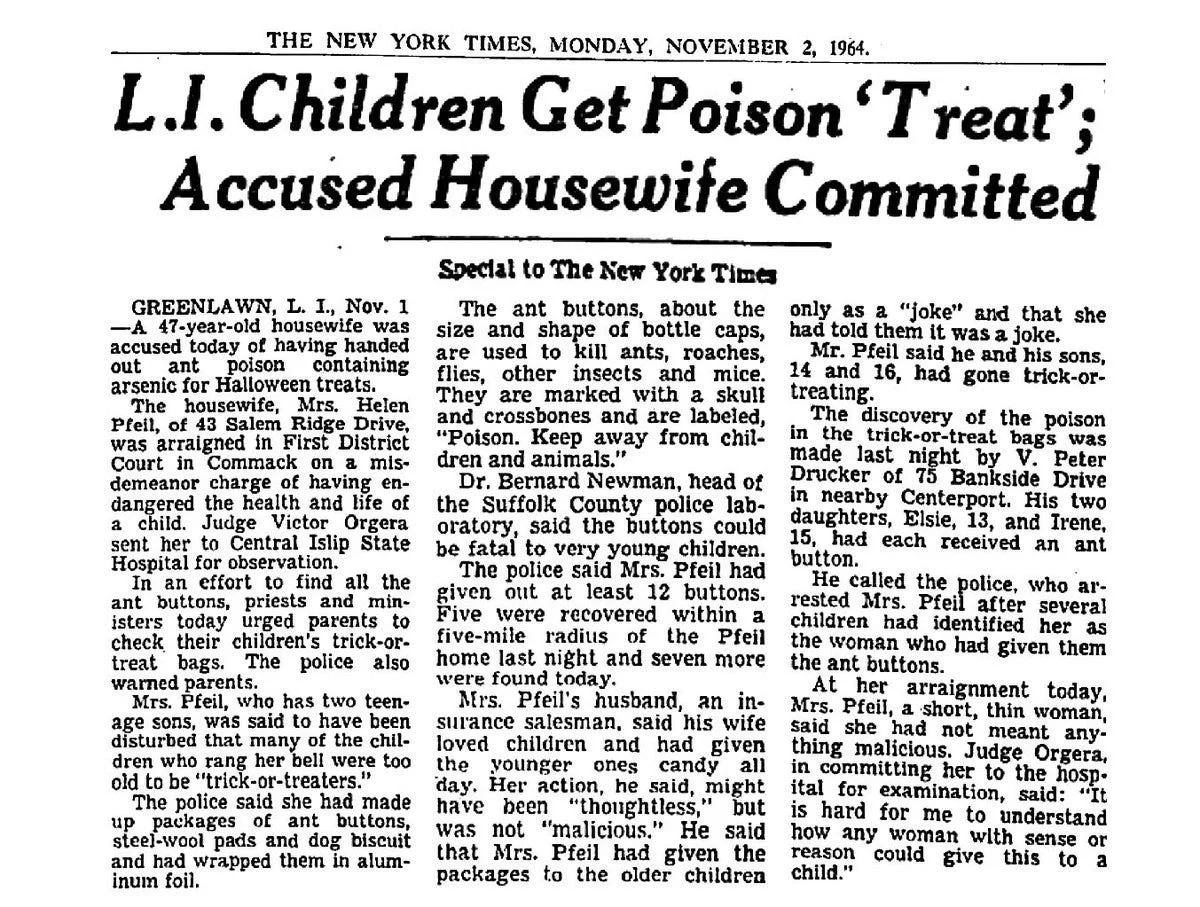
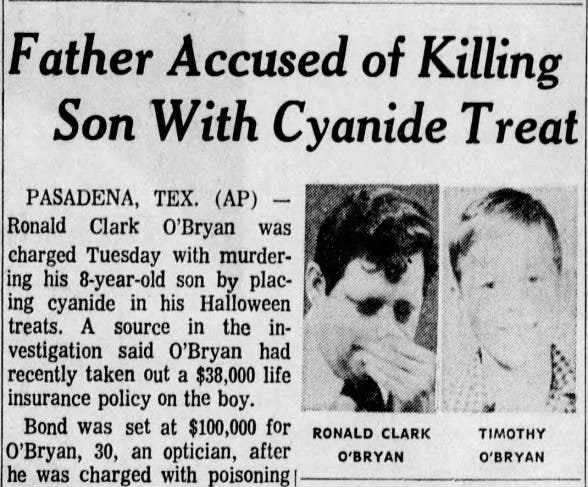
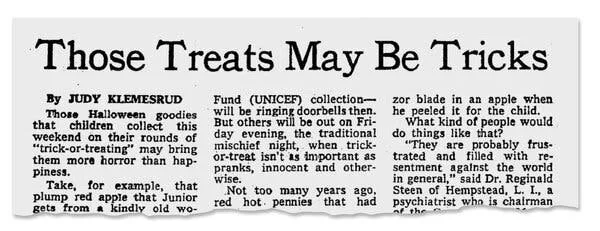
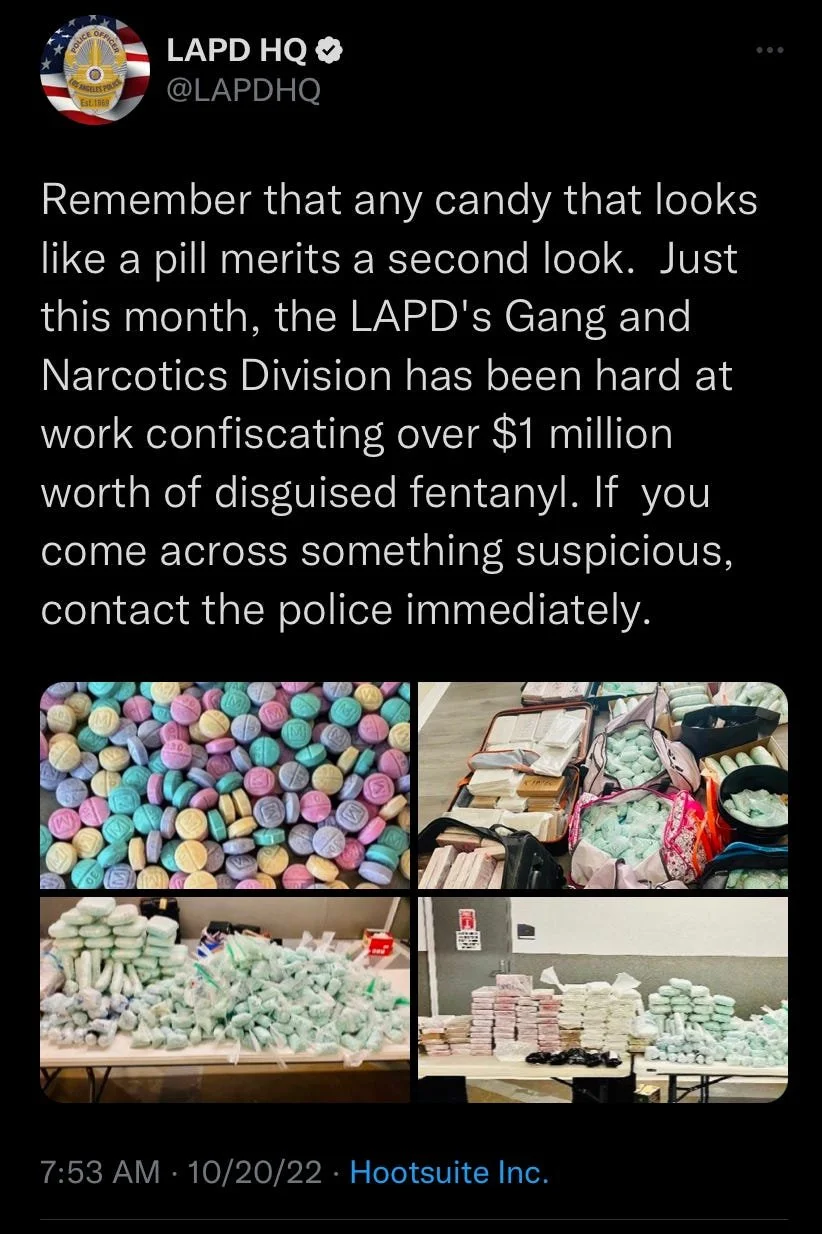
New York Times article from October 29, 1970, that helped start the contemporary poisoned candy myths.
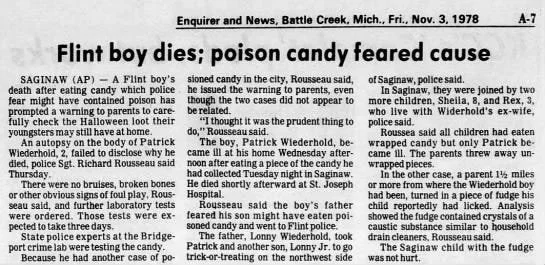
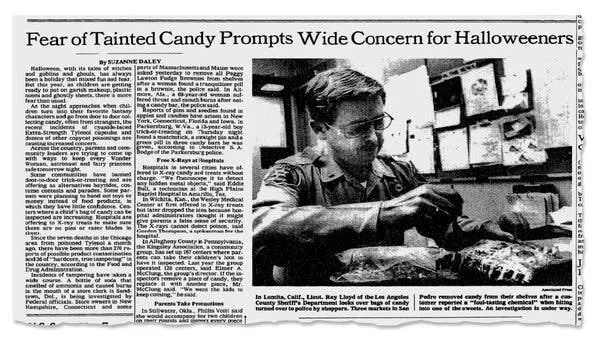

Bad Dreams
For almost thirty years the US government had made the suburbs possible by paying for the suburbanites’ houses, cars, roads, schools, hospitals, fire engines, prisons, and college tuitions. Then, in the mid-1970s, a series of economic shocks brought the post-WWII prosperity era to a shuddering halt. American politicians assumed they could tap into the wealth that had been steadily accumulating among the suburbanites for the benefit of the very social welfare programs that had led to the creation of the suburbs in the first place. But the suburbs were defined by one thing: property (which, as Cheryl I. Harris has shown, includes whiteness). If the suburbanites had anything, if they were anything, if they could be anything, it was property — houses, cars, other assets as capital property, families as patriarchal property, racial status as social property. Anything that threatened the value let alone the possession of that property was a threat, and a threat to them was a threat to the “real” Americans and thus a threat to America itself.
Not only would the government keep paying, the money wealth would now flow away from the urban areas generating the resources and towards the suburbs where it would collect and disperse into consumption (and debt). White suburban rage erupted against the government and the racially-diverse cities in the late 1970s in the form of tax revolts, busing protests, and a general backlash against the civil and human rights gains of the previous 40 years. Birthed as they were in racial capitalism and steeped in a culture of nostalgia, the suburbs were a comfortable fit for the mailing-list con-game conservative politics pioneered by Richard Viguere. But it was a strange “conservativism” as there was nothing to “conserve,” no traditions to protect, not even ideas to argue about, just phrases that politically speaking are barely concepts: “private enterprise,” “the border,” “traditional values,” “small business,” “small government,” “law and order.” The suburbs were the land of private desires, not civics. Suburbanites had no politics, but they had an unshakable ethos — individualism. It was a kind of negative politics; the very existence of a governing body, indeed the very political process itself, was an unfair imposition on the sovereignty of the white, self-directed ego.
Despite the suburbanite politics-against-politics, the electoral maps were drawn — and continually redrawn — to ensure the suburbs always had more than their fair share of influence. But what did they want with power? What would they use it for, besides keeping their zoning restrictive, their parking plentiful, their taxes low, their police on the attack against racial and economic intruders? What did the suburbanites want America to be? Was it "Reaganism,” that vague public populism founded on amoral economic austerity, manic militarism, and religious fanaticism? Or was that rather a suburbanite attempt to create a sense identity — what it “meant” to be suburban?
The problem with trying to create a new American identity as a nation of suburbs is that post-war suburbia has no history. Or rather, the history is: the suburbs were conceived, designed, built, and dwelled-in as a massive experiment in racial-economic exclusion, a conjunction of economics, demographics, geography, and white supremacy — but this true history is totally unacceptable to suburbanites as history. The true history of the suburbs was indigestible; the suburbanites spat it out. Instead of a history, they would have a series of competing obsessive stories: urban legends, rumors, patriotic myths, celebrity lives, media narratives. Instead of a past, they would have a series of competing compulsive presents: consumer trends, diets, fads, cars, cults, mass entertainments, their own synthetic religions, their own ersatz economies. The kind of self-authored reality-field every utopian community wishes for.
So why had their dreams become nightmares?
Spooky Stories
The suburbs had been a natural breeding ground for mistrust and suspicion since the early days during the Red Scare in the 1950s. In the wake of the shocks to the system of the mid-1970s, that suspicion twisted into ambient paranoia. Their individualism left them easy prey for roving murderers, which in turn made them even more fixated on their self-image as constant potential victims of crimes. Meanwhile, the crimes represented by the suburbs themselves lurked unacknowledged in plain sight. The place that was no place wanted a history that was not its real history, and the result was starting to breed monsters.
The suburbs of the 1980s grew darker. The neoliberal economics that helped give the suburbanites their disproportionate wealth started to turn back upon them. The companies that employed the suburbanites became global multi-national corporate entities and suddenly questioned the need for “redundancies” among their white-collar managers. They were more alienated from their work, their neighbors, even their own loved ones. It’s no coincidence that in the 1980s suburban fear fully bloomed. Real events like the Chicago Tylenol murders were implanted into the suburban subconscious, expressed as a stream of urban legends. They were especially convinced their children were constantly under threat; some of those threats were real, some were phantoms. At the same time, their egoistic non-politics led to led to a massive increase in income inequality in the US, redistributing wealth upward and causing social conflict that continues to the present.
In the 1990s the global economy finally came to cannibalize the suburbanites’ wealth. It was organized abandonment on a planetary scale and the suburbs weren’t spared. But the fabrication of the conservative self-image as a besieged suburban homeowner was complete; they were not about to denounce the economic status quo even as it drained away their affluence.
The suburbanites wanted to take out their rage on Black Americans, as they had always done, but this got them dangerously close to that true history they couldn’t stomach. Instead they fell back on the post-1970s language of “crime.” It made them feel good to fill the prisons, then build more prisons and fill them, and keep going until America had the most incarcerated people in the world. There was now a media apparatus that constantly reflected their own self-image back at them; it made sure to keep them on an anxious edge. The suburbanites rejection of their own true history had left them vulnerable to believing their own fantasies — now “media” and “reality” were merging and their children were, of course, in more danger than ever before. They were steadily losing their grip and would never regain it again.
Scary Movies
The decline of the suburbs during the rise of the Internet became the end of American politics as an expansion of wealth or possibility. It was replaced by the shrinkage of the imaginable future into smaller and smaller escape routes. The white suburbanites gaze at their personal screens and casually absorb a constant stream of conspiracy and fear. Their non-politics has curdled into jocular bloodthirst for their enemies and egoism unto death. The American suburbs, a place that was always no place, is now the no-place that is inescapable in America.
The philosopher Frederic Jameson wrote:
History is what hurts, it is what refuses desire and sets inexorable limits to individual as well as collective praxis, which its "ruses" turn into grisly and ironic reversals of their overt intention. But this History can be apprehended only through its effects, and never directly as some reified force. This is indeed the ultimate sense in which History as ground and untranscendable horizon needs no particular theoretical justification: we may be sure that its alienating necessities will not forget us, however much we might prefer to ignore them. - The Political Unconscious: Narrative as Socially Symbolic Act (1981)
Maybe another way of putting it is like this:
History is what hurts. Those who think they see ghosts are those who do not want to see the night. They crowd it with the terror of little images, they occupy and distract it by immobilizing it -- stopping the oscillation of eternal starting over. It is empty, it is not; but we dress it up as a kind of being; we enclose it, if possible, in a name, a story and a resemblance.
Under an Evil Hand, Part 6
Climax and aftermath of the Salem Witch Trials; the 1791 slave uprising panic in New York City; and mass psychogenic illness in twenty-first century upstate New York.
Note: this was originally posted to my Substack on October 27, 2022 (hence the “Happy Halloween” at the end). I deleted my Substack a couple years ago and I’m posting these here so they don’t get lost.
The Devil Rides Out
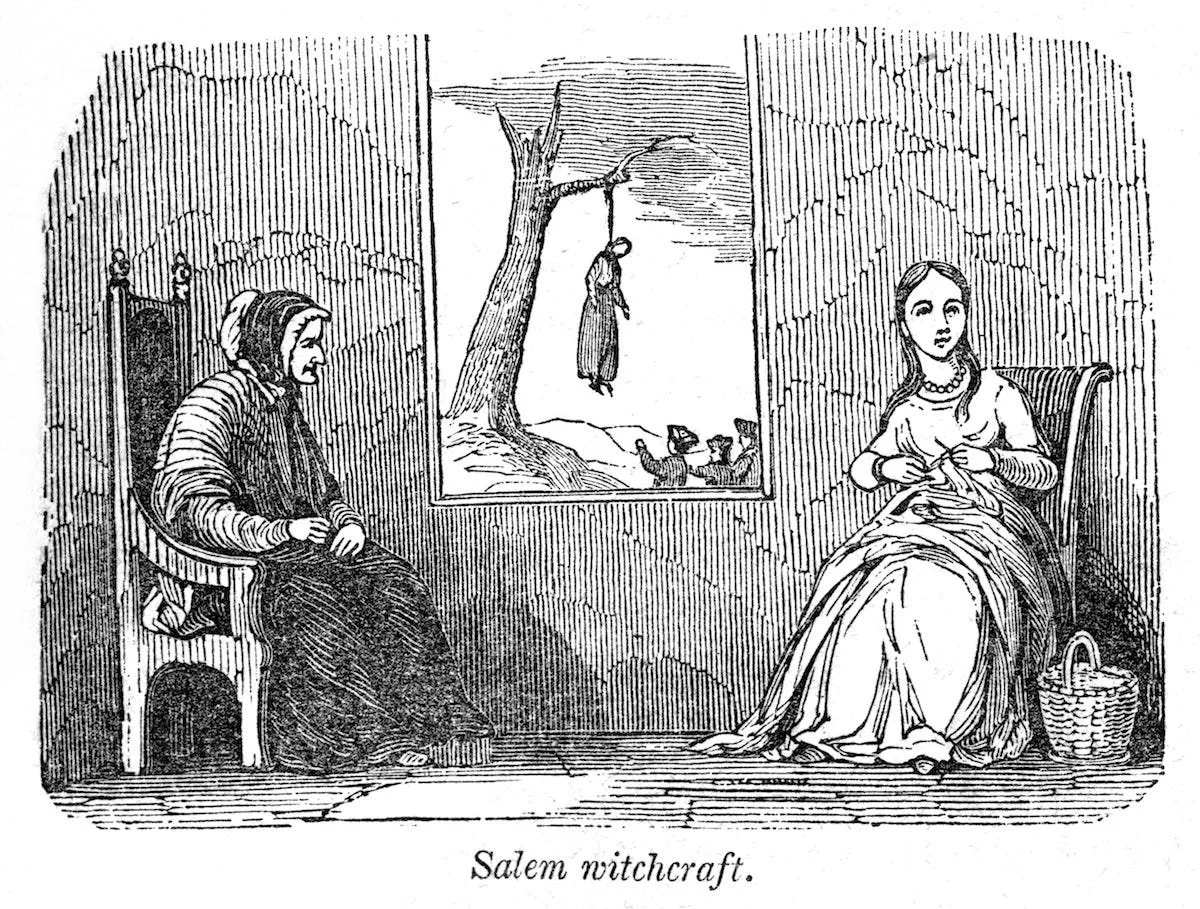
Massachusetts Bay Governor William Phips returned to Boston from his expedition to Pemaquid on September 29, 1692. In his absence, eight executions had taken place, defendants had been convicted on almost no evidence, and public opinion had turned against the witch trials. When Increase Mather himself denounced the use of spectral evidence on October 3, it was the beginning of the end. Without spectral evidence, the remaining cases had no ground to stand on.
The true end came when rumors spread about William Phips’ own wife possibly being implicated in the witch conspiracy. Enraged, Phips shut down the court proceedings, prohibited further arrests, and released many of the accused from prison. On October 29, Phips dissolved the Court of Oyer and Terminer. A new court was established that would convene in January 1693 to decide what to do with those still in custody. Throughout January and February defendant after defendant was found not guilty or cleared by proclamation of the Governor.
The last victim of the trials was a woman named Lydia Dustin, who died in custody on March 10, 1693. She had been found not guilty but wasn’t released because she was too poor to pay her jailer’s fees. The last trials were held on May 10, when five defendants were found not guilty, seven were cleared by proclamation, and a grand jury decided not to indict Tituba the slave, whose witchcraft had been blamed for the fits of Abigail Williams and Petty Parris a year and a half earlier.
“We walked in the clouds, and could not see our way”
Once it was clear the witchcraft trials no longer had the weight of the colonial government behind them, a fierce public backlash began. Families of the convicted spend decades trying to clear their names and get compensation. Publications appeared condemning the trials, though their authors were often harassed or even imprisoned for criticizing those in power.
William Phips came under attack for letting the trials go on so long; while the Mathers and their allies, the basis for his political power, turned on him for (in their minds) prematurely ending the trials. Despite his support from the Crown he had made too many powerful enemies in Massachusetts. He was recalled to England, where he was arrested on arrival in January 1965 on trumped-up charges of embezzlement. Before he could defend himself he fell ill and died at the age of 44.
Phips’ former ally, Increase Mather — whose work on witchcraft heavily influenced the trials; whose son Cotton was a driving force in the trials; who was present at the trial of George Burroughs, whose execution he celebrated — never expressed any remorse or even doubt about the righteousness of the trials. On June 27, 1692, while the trials were ongoing, Mather finished the charter for Harvard University and became its first president where he served until 1701. Even as Mather denounced spectral evidence he was preparing his book Cases of Conscience Concerning Evil Spirits which defended the trials and the judges. But the book was published in November 1692, after the backlash against the witch panic, so it included language cautioning the reader against acting too carelessly when hunting for witches.
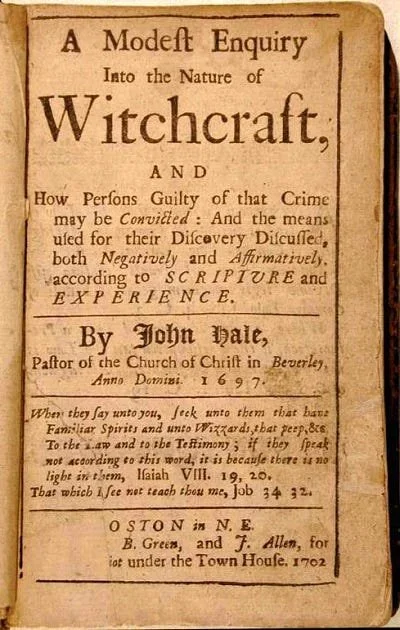
Unlike Increase and Cotton Mather, many of the New England worthies who had backed the trials eventually expressed their regrets. On December 17, 1696, the General Court ruled that there would be a fast day on January 14, 1697, "referring to the late Tragedy, raised among us by Satan and his Instruments." That same day, Samuel Sewall asked Rev. Samuel Willard to read aloud his apology to the congregation of Boston's South Church, "to take the Blame & Shame" of the "late Commission of Oyer & Terminer at Salem". He was the only judge who publicly renounced the trials. Thomas Fiske and eleven other trial jurors also asked forgiveness. John Hale, a minister in Beverly who was present at many of the examinations and trials, completed a book about the witch panic in 1697, where he wrote: "Such was the darkness of that day, the tortures and lamentations of the afflicted, and the power of former presidents, that we walked in the clouds, and could not see our way." The book wasn’t published until 1702, after Hale’s death.
On August 25, 1706, Ann Putnam Jr. joined the Salem Village church. She asked for forgiveness from the congregation, saying that she meant no harm, but the devil had tricked her into denouncing the innocent, like Rebecca Nurse. Ann was accepted for full membership in the church. If any other accusers had doubts or regrets, we have no records of them.

The present-day site of Gallows Hill, Salem, Massachusetts, in 2016.
Various individuals had their convictions overturned through the years but it wasn’t until October 31, 2001 when all the accused were finally, officially proclaimed innocent. In January 2016, the University of Virginia announced that a team of researchers from the school had finally determined the exact location of Gallows Hill in Salem, the site of nineteen executions — a small, barren, rocky ledge overlooking the town, positioned so that those witches hung from the surrounding trees couldn’t be missed by the villagers below. The site, owned by the city of Salem, now overlooks a Walgreens pharmacy. A memorial to the victims, designed by Martha Lyon, was dedicated on July 19, 2017, the 325th anniversary of the hangings of Sarah Good, Elizabeth Howe, Susannah Martin, Rebecca Nurse, and Sarah Wildes. Curving around the hill is a wall with the names of the nineteen victims engraved in the stones.
The New York Arson Panic of 1741, and Histories of Madness
In February 1741, three enslaved people in New York City robbed a small store owned by a white couple. One of the slaves, a man named Caesar, brought his loot to a tavern of ill repute down by the docks. The tavern was owned by a man named John Hughson, known for fencing stolen goods from slaves in exchange for alcohol. Before he could enjoy his spoils Caesar was caught and arrested along with one of his partners, a slave named Prince.
About a month later, on March 18, a fire broke out at Fort George, at that time the home Lieutenant Governor George Clarke. This was followed by a rash of unexplained fires across all of Lower Manhattan. The fires increased in number, reaching a climax on April 6 when four fires broke out in a single day. After a local enslaved man named Cuffee was seen running from one of the fires, he was arrested under the suspicion of having set it despite the lack of any proof he had done so.
A judge named Daniel Horsmanden was appointed to lead the investigation into the fires — at the same time he was presiding over the burglary trial of Caesar, Prince, and John Hughson. Judge Horsmanden was convinced that the burglary and the fires were was somehow connected. He and other white New Yorkers wondered if they might be facing a conspiracy, possibly a slave revolt using the weapon of arson.
The colonies had seen a major slave uprising in North Carolina two years previous, so it wasn’t hard to believe that another revolt was happening. And because Manhattan had the second-largest slave population of any city in the colonies (after Charleston, South Carolina), the idea of a slave revolt on the island was terrifying to white New Yorkers. Meanwhile Protestant Britain had been at war with Catholic Spain for the last two years and anti-Catholic bigotry was running high in the city amidst fears of an attack by Spanish forces. African-born slaves, Roman Catholics, and Black Spaniards were all suspect.
A jury was impaneled on April 21. Mary Burton, a 16 year-old Irish indentured servant at Hughson’s tavern, was brought in to testify before the jury. Under duress, Mary testified that Caesar, Prince, Cuffee, and a group of poor whites had indeed conspired to burn down the city, kill all the white men, claim the white women for their own, and elect a new king and governor from among their ranks. Burton also implicated a white prostitute named Peggy Kerry, who was connected to Caesar. Peggy Kerry was in turn forced to testify; to save herself, she implicated numerous other slaves in the conspiracy. Those she named were arrested and they too were also forced to provide testimony and name names.
In May 1741, Caesar and Prince were charged not with conspiracy, but with burglary; they were hanged. Peggy Kerry, who was pregnant with Caesar’s child; tavern owner John Hughson; and Hughson’s wife were arrested and publicly executed in June. Hughson’s body (and possibly those of his wife and Kerry as well) were hung on a gibbet and left to rot for all to see.
Despite the series of arrests, trials, and executions, Judge Horsmanden had still not uncovered any solid evidence of a plot to burn down New York City. He began to offer monetary rewards to anyone who could provide such evidence. By the end of the three-month investigation, about 150 people had been arrested and either testified or confessed. Mary Burton continued to accuse and implicate conspirators into the summer of 1741. She eventually accused more than twenty whites, including a man named John Ury, a Latin teacher who was supposedly using his Catholicism to influence the rebellion. He was eventually hung, along with about thirty enslaved people overall. About eighty others, mostly Black but some white, were deported and sent to Newfoundland, the West Indies, and the Madeira islands.
For whatever reason, the wave of fear had passed by the end of the summer and the accusations and trials ended. After all that bloodshed and horror, no real evidence of a plot was found. There might well have been a conspiracy to burn down Manhattan. It might have been a lone arsonist. It might have been a strange coincidence. It might be part of a pattern of “pre-emptive” violence against enslaved people. It might also be that human fear and cruelty slips through our attempts to rationalize and explain and thus comprehend.
Can a sane person write a history of madness? Sometimes the best we can do is record and observe, look for patterns, make some conclusions, and keep away from grand narratives. That’s why these posts are written in this style. I originally wrote most of this as a script to be read aloud, so the style is relatively simple and almost flat. Instead of embellishing it I kept it mostly as-is. To me there is still mystery at the core of the witch panic — as I’ve tried to show, I think it’s a force that socially recapitulates itself — and I don’t want to try to explain it away.
Thera Sanchez in 2012. Credit: CNN.
Psychogenic Illness In Upstate New York
Le Roy Junior-Senior High School sits in New York State about 50 miles east of Buffalo. In August 2011, a 16 year-old Le Roy student named Lori Brownell, passed out suddenly at a rock concert. A month later, Lori passed out again, this time at her school’s homecoming dance. Her doctors put her on Celexa, but she only got worse. Her fingers fluttered, her hands clapped, she shouted “hey,” almost like she was involuntarily cheerleading. She tried to manage her tics, outbursts, and seizures the best she could, while her doctors continued to look for some medical cause. They could find none.
In the meantime other children at the Le Roy school had come down with the same or similar symptoms as Lori’s. Eventually 20 people, almost all of them girls who were students at Le Roy Junior/Senior High School, were suffering from verbal tics, spasms, nausea, dizziness, seizures, and other symptoms, as if they had all caught Tourette’s syndrome, except Tourette’s isn’t a contagious disease. The school and the state department of health looked for environmental factors that might have caused the outbreak but found nothing. Perhaps the symptoms were a side-effect of drugs, medications, vaccines, trauma, genetic factors, a rare condition known as PANDAS – pediatric auto-immune deficiency syndrome. Still nothing. The mysterious illness garnered local television and newspaper coverage of the girls, and eventually attention from national news and even the BBC in Britain. Meanwhile the girls were posting their own videos to YouTube showing their symptoms, and describing their ordeals on Facebook posts, attracting even more attention from around the globe.
By early January 2012, the authorities had settled on an explanation for what was affecting the girls but they were strangely reluctant to share it with the public. During a community meeting the New York State Department of Health said they couldn’t reveal their diagnosis because of concerns about the students’ privacy. Five days later, two of the girls appeared on the Today Show on NBC television to discuss their condition. They vented their frustration with the authorities for withholding information from the families affected.
As a result of this public pressure, a neurologist named Dr. Laszlo Mechtler, who had been treating most of the girls, was allowed to share the agreed-upon diagnosis: mass psychogenic illness. Psychogenic illness, aka conversion disorder, is a disorder that arises from a victim’s psyche dealing with stress, trauma, or depression by manifesting physical symptoms. The physical distress is real, and physical, but originates in the mind.
The families were mostly not pleased with this diagnosis. To them it seemed to imply that the girls were essentially making it all up or were simply crazy. And not everyone agreed; the environmental activist Erin Brockovich was convinced that the fits were caused by cyanide and an industrial solvent that spilled from a nearby train derailment back in the 1970s. According to Brockovich the spill had contaminated the soil around the La Roy school, though no trace of pollution was ever found.
Dr. Mechtler and others advised the girls to stop posting about their condition on the Internet and to stay off of social media in general as much as possible. Some of the girls did so and started to improve as a result. In June 2012, the symptoms began to clear up as suddenly as they appeared, except for two girls who were found to have actual cases of Tourette’s syndrome. As the school year drew to a close, the girls seemed to be healed and mostly moved on with their lives.
The exception was Lori Brownell. She and her mother had rejected the diagnosis of conversion disorder and its implication that what had happened to Lori wasn’t real. They had refused to allow Lori to be treated at the same neurology center as most of the other girls. Instead the Brownells decided that Lori was suffering from a chronic form of Lyme disease that was difficult to detect. This required long-term doses of intravenous anti-biotics and other treatments and appointments, which the Brownell’s insurance eventually stopped paying for. In the face of these struggles, Lori persevered. She graduated from high school in 2014 and has faded from the national spotlight as she, too, tried to move on with her life.
Since the Le Roy outbreak, various psychologists have come to the conclusion that mass psychogenic illness – which sounds like an updated term for what was once called “mass hysteria,” but isn’t — made a comeback in the 2010s after a long decline. The new technologies of communication and intimacy have allowed the old fears, the old paranoias, the visions, to spread wider than any time in human history. They have enabled that evil hand that was present in Salem Village to cast its shadow across the entire Earth.
Postscript: Season of the Witch
I wrote most of the above text in 2017. At that time I was fascinated and disturbed by the Q Anon Internet-cult that had just recently progressed from Pizzagate to Russiagate to openly venerating Donald Trump and his lackeys. At the time they were still a relatively on-line phenomenon that was just starting to break out into non-Internet reality in oddities and acts of violence. How quaint!
Jan 6 was the apotheosis of Q, the culmination of years of misinformation, hatred, bigotry, resentment, and pent-up backlash. Incoherent fears of Black Lives Matter “terrorists” who were joining with ANTIFA to literally burn cities to the ground; free-floating rage over the suffering inflicted by COVID, sublimated into rage at the hapless, half-hearted attempts to contain it; the perversion of America’s youth through critical race theory and/or trans rights; and of course a Satanic (etc.) conspiracy operating in the shadows — but also inside the government— who kidnapped, abused, and killed children, not to mention stealing elections. The right-wing disinformation engine realized the mass delusions brought in ratings and views, they co-opted the fanatics and con men who had appointed themselves as cult leaders, and they shoveled all that garbage like anthracite coal into the boiler of that engine until it exploded on January 6, 2021. That was also the day Q as a “movement” ceased to exist. Q had done its job becoming the dominant mindset (it’s not an ideology, that would take ideas) of the Republican Party. As soon as the fantasies of the Q cult transfigured from 8chan to the ballot, the cult abolished itself.
Like Q, it seems to me that past panics were viral paranoias wherein the more information someone received from others the more likely they were to join in the fear. The Internet would obviously magnify this effect a million times over. Based on the constant panics and terrors from 2017 to the present, that assumption turned out to be true.
I also believe that in an unforgiving, violent, unjust, nakedly cruel society — like ours — the instinct to push back and regain our autonomy hits against our need for self-preservation and a thousand other factors. Our desires for active resistance, passive resistance, self-destruction, and escape from the horrors of reality itself, all get braided together. This cable of contradiction can sometimes express itself in an individual through conversion disorder, and that individual expression can somehow spark the same in others, perhaps several others, creating a critical mass. Precisely how and why it all happens is the mystery of Salem and its descendants, a mystery I don’t think we can solve with the faculties of reason.
It happens that as I write this I’m in a hospital bed in Boston, being monitored 24/7. The neurologists want to see what it looks like when I have a seizure, so I have to wait here at least 5 days while they stress me out to see what happens. I don’t think they will find anything “physically” wrong with me — because I most likely have conversion disorder. It took two years to get to this point because all the CT scans and MRIs couldn’t peel the lid on my subconscious mind. It’s my own mystery now. Maybe I, like the Le Roy students and the Salem girls, will see my condition simply fade away.
In a way this gives me some sense of what the fits might have been like: uncontrolled, brought on by specific stressors, sometimes like panic attacks, other times as the loss of sensation, balance, and ability to speak, other times blacking out completely. I don’t want to presume, though. The eyewitness accounts make it clear that the fits of the Salem girls were more severe and probably even more debilitating.
It’s clear to me at least that the girls weren’t faking or acting. There were probably a few feedback loops going on: one among the girls; one between the girls and the audience at the trials, who were vocal enough to be participants; and one connecting the girls, the audience, and the judges. There’s no incentive for anyone in these loops (except skeptics and other outsiders) to pull back against the centrifugal force if these loops, just the opposite. Once the proceedings got big enough the “contagion” could spread to a wider area; then the process would start again until it hit an immovable object (like William Phips) or burned itself out for whatever reason.
There’s a bagful of morals to choose from regarding the witch trials. It’s a parable about repressive religion, feminist resistance to patriarchy, genocidal colonialism, what happens when rigidly hierarchical, highly unequal social structures begin to crack. It reflects the chaotic blowback from the complex internecine power struggles in colonial New England. It’s the tragic final chapter to an centuries-long era of witch hunting. It’s an organic outgrowth of the pseudo-modern blend of old theology and early science, which led the Mathers to believe they could hunt for witches using sound empirical data. In my opinion none of these contradict each other, and they are all fascinating. So is there a mystery after all? Is there just something that resists analysis because it’s closer to primal fright than higher reasoning?
The popular iconography in Salem itself of the witch trials is telling. The trials are always presented as theaters of insanity, horrors in their own right, where simply being accused was a death sentence. A trial where the evidence is made up of phantasms is a mockery of the idea of a trial. The trials are scary, as long as one rightly assumes that witches and witchcraft (as imagined by the Puritans) are fantasies.
On the other hand, fantasies have the strengths of imagination and desire behind them. The image of The Witch herself is everywhere in Salem: usually as an unthreatening caricature, sometimes as a woman of mystic power, but always there. The trials were full of imagined witches, too, also with ambiguity: empowered by the Devil to do evil but in the end defeated by Christ and his chosen.
These obscurities, trials that weren’t trials of witches who weren’t witches, don’t resolve at any point. Neither do the symptoms of psychogenic illness have a medical cure. The ambiguity shimmers in history and in our lives like mirages close enough to see but never to grasp. That eerie unknowability, that strange space we sometimes inhabit, is, after all, the essence of spookiness.
Happy Halloween…
Under an Evil Hand, Part 5
The Salem Witch Trials claim more lives; theories about the witchcraft crisis; and the New England Vampire Panic.
Note: this was originally posted to my Substack on Oct 20, 2022. I deleted that Substack a couple years ago and I’m posting these here so they don’t get lost.
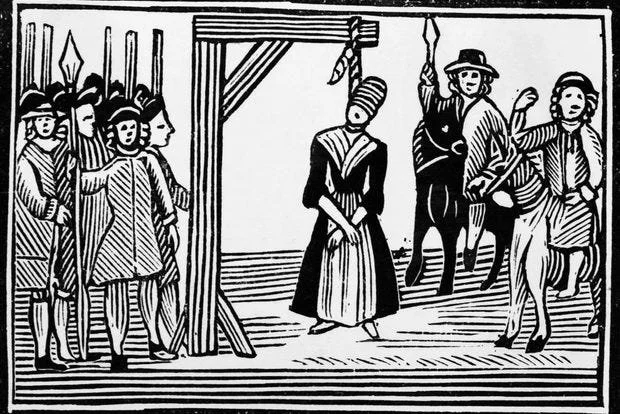
“The Devil Transformed into an Angel of Light”
After the execution of Elizabeth Bishop on June 10, 1692, there were two weeks of relative quiet. No new suspects were jailed and there were only (so to speak) three spectral attacks. During this lull the first reservations crept into the minds of some colonists. There had always been a few who spoke out loudly against the trials — which made them all the more suspect. By this point most of those dissenters were on trial themselves. Some of the local clergymen cautiously expressed their confusion and dismay about prosecution’s tactics in the court trials, always couched in effusive praise of the magistrates. Boston minister Reverend William Milborne started two petitions which he intended to present to the new Massachusetts assembly when it convened, condemning the charges against some of the prominent citizens that had been accused, like Rebecca Nurse, George Burroughs, and several others. But when Governor William Phips and his council got wind of it Milborne was ordered to either pay a large fine or be imprisoned. He stood by his convictions and was thus thrown in jail. Also during this time the family of Rebecca Nurse had been fighting back against her indictment for witchcraft, publicly attacking the credibility and character of her accusers, especially Abigail Williams, Betty Hubbard, and Mercy Lewis.
The court reconvened on June 28. Despite her family’s efforts, Rebecca Nurse was tried and found guilty, along with Sarah Good and three other women. One accused man, Roger Toothaker, had already died in prison on June 16, making him the trials’ second victim. On July 19, the five convicted women were executed by hanging at Gallows Hill.
Not only did these executions fail to stem the rising tide of paranoia, the killings only fed the expanding cycle of accusations and confessions which by now had spread to Andover, then Gloucester, then all of Essex County. As August 1692 began, Gov. Phips, who had prudently distanced himself from the court proceedings, traveled north to Maine to oversee the improvement of the province’s defenses. In his absence the convictions and executions continued.
On August 19, George Burroughs, John Proctor, Martha Carrier, and two other men were executed by hanging on Gallows Hill. Burroughs had been considered the leader of the witch conspiracy for several weeks. Local people had packed the courtroom during his trial and so they flocked to his execution. One observer noted that the condemned “forgave their accusers” and “seemed to be very sincere, upright, and sensible of their circumstances on all accounts.” Another man present described how Burroughs, before the gallows, made an eloquent speech declaring his innocence and finished by perfectly reciting the Lord’s Prayer, which brought many of the onlookers to tears. The authorities became concerned that the crowd was so moved they might try to stop the execution, so they hurried to hang Burroughs was hung before they could do so. As soon as Burroughs was hung, Cotton Mather leaped onto his horse and exhorted the people to remember that “the Devil has often been transformed into an Angel of Light.” This supposedly had the effect of calming the crowd. The executions would continue.
The court convened for another session on September 5, and over the two weeks the juries tried several more men and women, including Martha Corey. All of them were found guilty. Abigail Hobbs, who had confessed to being a witch several weeks prior, pled guilty, and found herself one of the few confessors who were prosecuted. The court seemed to be in a rush; it was no longer even following its own lenient standards for evidence and testimony. Eight more people, Martha Corey among them, were hung at Gallows Hill on September 22.
In the meantime, the court had to deal with the problem of Martha Corey’s husband, 81 year old Giles Corey. He stubbornly refused to enter a plea of guilty or not guilty to the court, despite being legally ordered to do so. As a result, on September 17, the sheriff led Giles Corey to a pit in the open field beside his jail. Following the law of the time the sheriff stripped Giles naked before the Court and other witnesses. He laid Giles on the ground inside the pit, then placed wooden boards over his stomach and chest. Six men put heavy stones one by one on the boards. Despite the pain, Giles remained silent. Over the next two days he was given a few mouthfuls of bread and water. He was asked three times to plead innocent or guilty to witchcraft, and each time he replied simply "more weight." As the rocks piled up, the sheriff would occasionally stand on them to add to the pressure. But Giles wouldn’t give in. On September 19, three days before his wife’s execution, Giles supposedly cried out “more weight!” one last time before finally dying — though other observers said that with his last breath he cursed both the sheriff and the town of Salem.
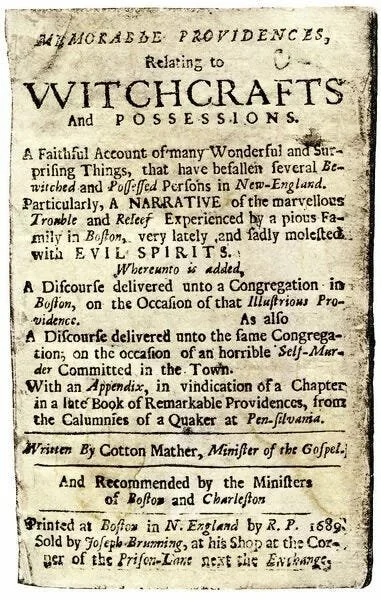
What Were the Salem Witch Trials?
The Salem witch trials of 1692 and 1693 stand out among the long history of witch trials in Europe. For one thing most of the Salem Village accusers were girls between the ages of 9 and 19 years old. There were older accusers, like Mary Warren, who was 20; Ann Putnam Senior, who was 30, and the oldest, Sarah Vibber, who was 36. But mostly the accusers in Salem Village and, later, Andover, were in their teens or younger. These young women had perhaps the least amount of social status in Puritan New England, apart from total outsiders like the Native Americans, the French, and the Dutch. But the adults in the colonies not only listened to these girls and took them seriously — they tried, convicted, and executed prominent members of their own community based mostly on their unreliable testimony.
The witch trials upended the social hierarchy in Salem, and that society, as we’ve seen, was already unstable, under severe attack from Indians and their allies and in a state of uncertainty at every level of government. These would be rational causes, but the sheer terror, the pervasive irrational fear at the heart of the Salem trials has remained a black box for historians who have tried to explain, or even just comprehend, what exactly happened in 1692 New England.
There are so many theories about the cause of the witch panic they can be grouped into types: physiological explanations, economic explanations, and psychological explanations. One well-known physiological theory holds that the accusers ate some rye infested with the ergot fungus, which caused hallucinations, pain, and convulsions, consistent with the accusers fits. But there is no real evidence to support this theory, or similar theories blaming encephalitis or an outbreak of Lyme disease.
Economic explanations are probably the most commonly accepted theories at the moment. One theory traces the source of the witch panic back to the global cooling that occurred between 1550 and 1800, known as the Little Ice Age. The coldest period fell between 1680 and 1730, meaning the ten years leading to the trials would have been especially difficult. The winters were severe, leading to food shortages and other hardships, and in turn — possibly — the scapegoating of outsiders into witches. Another theory points out the class difference between the relatively wealthy merchants of Salem Town to the east, with the relatively poor farmers of Salem Village to the west. This theory claims that the witchcraft trials were a way for the poorer Villagers to strike back at the unfairly privileged Towners. The economic explanations for Salem have the advantage of providing rational causes for the behavior of the Villagers, but that reasonableness is itself a problem. It’s hard to believe that the Salem folk were motivated by rational economic self-interest to tear their own society apart.
If we argue that the villagers were unconsciously motivated by economic factors, that Freudian language takes us into the realm of the psychological. The psychological explanations include the theory that the Villagers were suffering from (what we now call) post-traumatic stress disorder as a result of years of brutal warfare against the Wabanakis. Another psychological theory proposes that the girls were pushed into a kind of neurosis by straining against their strict Puritan upbringing and their low social status. Their fits supposedly stemmed from this mental struggle, and then the fits themselves became a tactic in continuing that struggle. A related theory posits that the girls felt controlled and constrained specifically by the older Puritan women. The girls used the accusations to project their own anger and resentment onto the married or widowed women, making those women responsible for the girls’ own rage which could not be openly expressed in any way.
The problem with these theories is that it’s difficult to either verify or disprove what anyone’s mental state is at any time, let alone hundreds of years ago. For these posts I’ve relied heavily on the work of Mary Beth Norton and her excellent book In the Devil’s Snare, mostly because she uses original sources wherever possible, creates a clear timeline of the witchcraft crisis, and incorporates the wider context of the bloody fighting between the colonists and the indigenous people. Many of the original records about the witchcraft trials were either lost or deliberately destroyed by those who participated in them, but enough have survived that we can at least understand what happened, if not why.
The simplest explanation, of course, is that it all really happened the way the accusers said it did: Cotton Mather was right, the Devil recruited a conspiracy of male and female witches and had them join forces with the Indians to drive God’s chosen out of their promised land. Of all the theories that try to explain the Salem witch trials this one remains the least popular of all.
The Last Vampire of New England
In June 1784, the Connecticut Courant and Weekly Intelligencer printed a letter to the editor from Councilman Moses Holmes of Willington, Connecticut. He warned locals to beware of “a certain Quack Doctor, a foreigner” who had urged families to dig up and burn dead relatives in order to stop the spread of “consumption,” i.e. tuberculosis. Homes, to his disgust, had witnessed several children’s corpses exhumed at the request of this Quack Doctor and was publicly calling for it to stop.
This practice of exhuming the bodies of those who had died of consumption — and usually burning part or all of them — was a New England tradition, ensuring that the dead would not rise from their graves to infect others. If multiple members of the same family died of TB, it was often blamed on the dead coming back to infect their living relatives. There were at least 80 exhumations dating as far back as the 1700s and as far west as Minnesota, but most were in rural New England in the 1800s.
In Connecticut, Rhode Island, and Vermont, the corpse would be exhumed, its heart cut out, and the heart burned; in some areas, it was thought that inhaling the smoke of the burning heart could cure those who were already sick with consumption. In 1793, hundreds of people attended a heart-burning ceremony at a blacksmith’s forge in Manchester, Vermont. In Woodstock Vermont, a heart was burned on the town green in 1830. Several corpses were exhumed at the same time in Jewett City, Connecticut in 1854. In Plymouth, Massachusetts, those who died of tuberculosis would be dug up, removed from their coffin (if they had one), flipped facedown, and reburied. That way if they tried to claw their way out of their graves they would end up going in the wrong direction.
Gravestone of Mercy Lena Brown.
In the 1880s, George and Mary Eliza Brown lived in Exeter, Rhode Island, on a homestead of between 30 to 40 acres. Tragedy struck in December 1882 when Mary Eliza died of tuberculosis. The next year, their oldest daughter, a dressmaker named Mary Olive, died of tuberculosis at the age of 20. The whole town of Exeter came to funeral and sang hymns for her.
In 1891, George’s daughter, Mercy Lena Brown, and his son Edwin both came down with TB. Edwin was a large, healthy man — it seemed he might be able to beat the illness, so he traveled to Colorado Springs to recover. He returned in worse shape than when he left, which of course struck people as strange. The locals in Exeter began to wonder of perhaps Mary Eliza or Mary Olive Brown had returned from the dead to cause Edwin’s illness. When Mercy Lena Brown died in January 1892, it was decided that something had to be done. After months of pressure, George gave his permission to have his dead family members exhumed and examined. He also made it clear he would not be present.
On March 17, 1892, the villagers, a local doctor, and a newspaper reporter for the Providence Journal exhumed the bodies of the Browns. The examiners found that Mary Eliza and Mary Olive had significantly decomposed. Mercy Lena Brown, however, looked rather healthy. The doctor made some other incisions and pointed out the clear TB infection in Mercy’s lungs. Nevertheless she had blood in her heart and liver, which was taken as a sign that she was perhaps undead. (Of course, her body had been in an above-ground tomb in cold weather, which kept her preserved; she had only been dead two months; and the blood of dead bodies tends to pool in the chest cavity.)
Mercy’s heart and liver were cut out and burned on a nearby rock. The ashes and other remnants were mixed with water and given to the now-sickly Edwin to drink. It was supposed to cure him, but you will not be shocked to know he died two months later. It was, however, the end of consumption in the Brown family.
Mercy’s remains were reburied in the cemetery of the Exeter Baptist Church. Her grave, to the dismay of her descendants, has become a tourist attraction. Some have come to pay their respects to Mercy as someone whose body was desecrated in the name of superstition and fear. But the majority are tourists of superstition themselves — ghost-hunters, weird-history buffs, enthusiasts of the paranormal, looking for any hint that the world has ever been something other than what it seems. Mercy Lena Brown was the last of the New England vampires. Her end was also the end of era where it was simply understood there was no firm wall between the living and the dead.
The Providence Journal’s reporting on the Exeter ritual was read by George Stetson, a famous anthropologist of the time who had traveled to Rhode Island to investigate this “barbaric superstition.” His own account was published in a prestigious journal and shortly the story spread around the world. The New York World published their own story on Mercy Lena Brown in 1896. This story was read by a stage manager for the Lyceum Theatre in London, Bram Stoker, who was touring the United States with the theater company that year. Stoker was working on a novel he called The Un-Dead, which he changed right before publication in 1897 to Dracula. One of the characters in the book is named Lucy. She seems to suffer from something like consumption, though Van Helsing, the doctor, realizes that something more evil is afoot. Later, Lucy dies, and in a pivotal scene, her corpse is exhumed, a ritual presided over by the doctor. Eventually she is turned into a vampire, and the main characters have to destroy her, in part by driving a stake through her heart.
Continued in Part 6.